Build Your Own Water Powered Car
Build Your Own
Hydrogen & Oxygen Generator
- That does not use brute-force electrolysis -
Run Your Car On Tap Water! *
Build a Hydrogen Powered Car
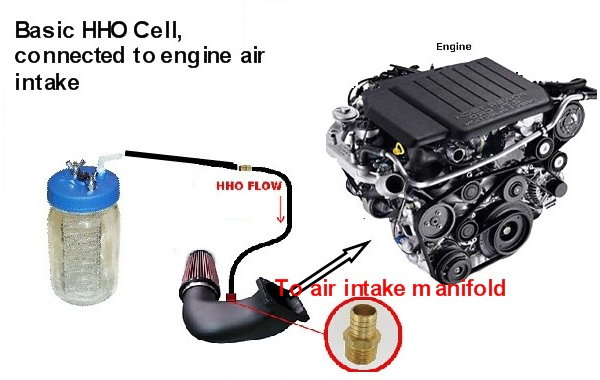
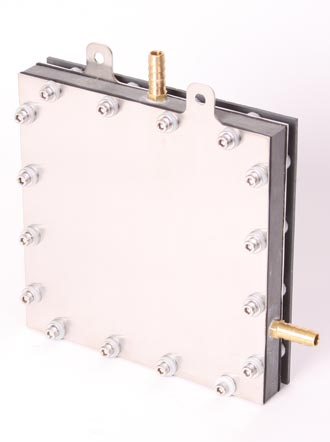
* A cannister, under the hood, containing electrodes (about 1.5 mm apart), is (almost) filled with water. The water is separated into hydrogen and oxygen, on demand, when the engine is started, and the hydrogen produced is directed into the engine through the air intake, which may or may not be mixed with gasoline, sprayed in, also. The hydrogen, a gas, explodes, completely, 100%, not just some small percentage like the liquid gasoline (or diesel) being sprayed in with it.
Gasoline, the liquid, does not explode in your engine, either. Liquid gasoline, or diesel, is sprayed into the engine. Of that, the small amount that vaporizes off the surface, (abt. 10-15%?) explodes with the force needed to move the pistons and turn the crankshaft. Of that small percentage which vaporizes and produces energy, 65% is wasted as heat. Additional small percentages are lost in the drive train, etc. Most of the gasoline, still a liquid, is now hot enough to vaporize, react chemically (the oxygen has been consumed, even creating carbon monoxide), cool, and go out the tail-pipe as smog: soot, – toxic air pollution – stuff that poisons us and overheats our planet. Thank you “big oil”! … If interested, read
How The Oil Co’s First Took Over
A.K.A. The Oil Age That Never Should Have Been
A Better Hydrogen Generator
Instead of brute-force electrolysis, the traditional “sledge-hammer” approach, small, tuned, pulses are generated, like a tuning fork shatters a wine glass, with very little effort, not “free energy”, but smart, elegant, and cheap; instead of brute-force, crude, and expensive.
from Stanley Meyer’s project:
“The electrodes are vibrated with a 0.5 to 5 amp electrical pulse (depending on your speed and acceleration) which breaks 2(H2O) => 2H2 + O2. When the pressure reaches say 30-60 psi, you turn the key and go. When you step on the pedal, you send more energy to the electrodes, and thus more vapor to the cylinders; i.e. fuel vapor on demand.”
from Dave Lawton
“There is a very simple way to doing this WHOLE water powered system on 0.5 Amp!”
An extract from the lecture given by Admiral Sir Anthony Griffin to the Maritime Division of the Southampton Institute, Warsash, UK, Sept. of 1993:
“Electrical power with opposite polarities is applied in pulses to the inner and outer cylinders and at a power of 10 watts, i.e. 5 volts at 2 amps. A considerable quantity of gas immediately accumulates in the top of the vessel and, within 10 seconds, reaches a pressure of about 10 pounds per square inch.” or . . . apply “very high voltage (20,000+) pulses at a particular frequency, within positively and negatively charged voltage zones, at a very low current of less than 1 milliamp. The effect is … the covalent bonds between the hydrogen and oxygen atoms are broken and the two gases separated.”

Ronn Motors, Dennis Klein, Francisco Pacheco, Stanley Meyer, Daniel Dingel and others have all done it with their designs
see the history of Water Powered Cars
Example: Dennis Klein went 100 miles on 4 oz of water. (25 mi./oz.) We should be able to go at least 1 or 2 mi on an oz. of gasoline, don’t you think! (=128 mpg or =256mpg) We don’t because it has not been converted to a gas first. See our pages here on super carburetors. [by the way, 1 gal. = 128 fluid oz. ! . . and . . . Anyone who remembers their basic chemistry knows that 1 gallon of a liquid equates to about 1,000 gallons of it as a gas - in the gaseous state. :: 1 gal of water = around 1000 gal of hydrogen gas at normal room temp. and pressure.]
[Suggestion, just build the cannister and enough parts of the controller to generate the ultra sound frequency. Then, getting it to work, build the rest of the controller]
Daniel Dingel has run his car(s) for a number of years totally on water, also
Dennis Klein has run his car on water with and without a gasoline “supplement” — His “water mileage” was about 25 miles per ounce without any gas supplement. (3000+ mpg!) He was working with the military and the state of Tennessee.
“After Dennis was approached by auto manufactures and the US Government, the story changed.” -Charrington, May 29, 2007
“It is all over” Dennis is out of his co.. The oil monopoly has taken it over.
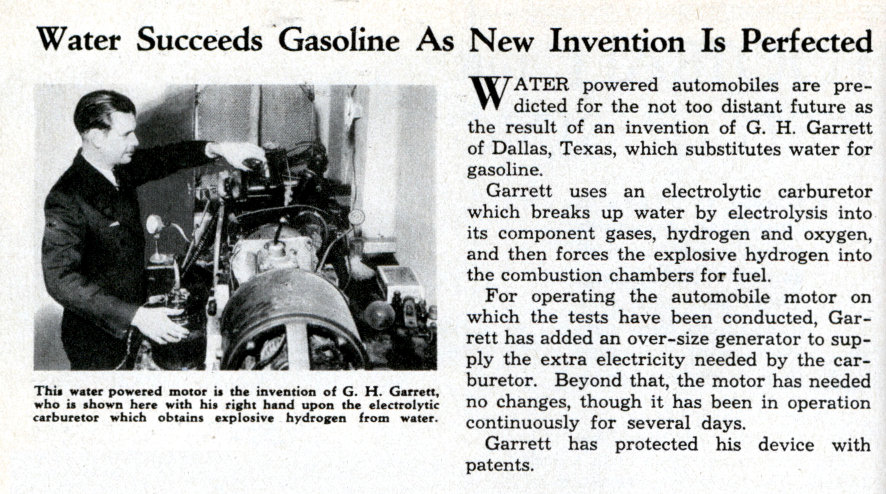
1935 – Inventor Henry Garrett patented a electrolytic carburetor and let a car run on tap water.
The late Henry “Dad” Garrett was a multi-talented Dallas inventor with a bent for electrical contrivances, and in 1935, he and his son, C.H. Garrett, patented and exhibited an automobile that ran on water — actually, on hydrogen after the water was broken down by electrolysis.
Dad Garrett was already famous for his work. In 1920 he set up WRR in Dallas, the world’s first municipal radio station, and was its first announcer. He was the first man to build a radio in his car, and he developed radio transmission from the car for police use. He also invented an automatic electric traffic signal, possibly the nation’s first.
On September 8, 1935, The Dallas Morning News first announced that the water-fuel concept worked — at least it worked for “several minutes,” the article reported. A few months later, Pathe’ News filmed the car driving along Garland Road with the driver stopping at White Rock Lake to fill the fuel tank with water before cruising off.
One can also see the Orion Project’s work on repeating Stanley Meyer’s success

Stanley Meyer was killed, now, May 13th 2010, the O.P. is under attack, being suppressed!
read about it!
The text, below, sent from an anonymous individual was edited slightly for better reading. The following is his/her words and drawings, which has been given into the public domain.
Everyone should rt. click on the diagrams to view and download or print them, and also “cut and paste” the text they want into a file and, perhaps, print that also.
Spirit of Ma’at LLC
Diagrams
Figure 1

Figure 2

Figure 3

Figure 4

Figure 5
click to see enlargement

Figure 6

It is suggested you try this out to begin with on a second vehicle you own, one that you don’t need to live with everyday, until you perfect this technology.
In putting these plans into operation, you will be making use of your entire existing system except for the fuel tank and the catalytic converter.
take a look at this video generating hydrogen gas with a small amp.
http://www.youtube.com/watch?v=kvdPLJW06pw
The Plan
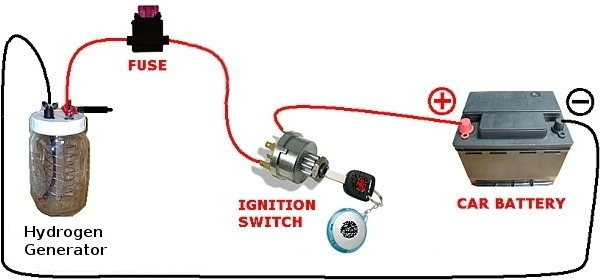
Build and install a low-cost alternative method for running your vehicle (internal combustion engine) on tap water, using off-the-shelf components.
This is supposed to be an efficient way to convert ordinary tap water into gaseous hydrogen and oxygen, and then burn these vapors in the engine, instead of gasoline.
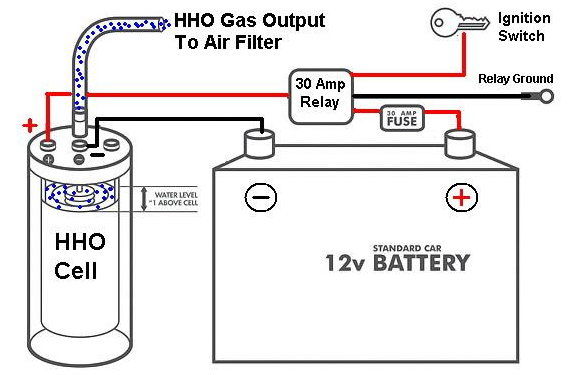
This “minisystem” runs easily from your existing battery and electrical system, and it plugs into your carburetor [Fuel Injectors] with simple off-the-shelf fittings.
You will be installing a plastic water tank, a control circuit, a reaction chamber, a hi-pressure carb/FI fitting, and 3 gauges, and then hooking into your existing carb/FI. [Fuel Injectors]
The simplicity comes from its being an “on-demand” system requiring no fancy storage or plumbing. You crank the gas pedal or throttle, and you electrically [/sonicly] create more vapor for immediate consumption, on demand; low-high flow rate as needed, from idle to maximum power. The change is that you are using tap water as fuel, instead of the traditional petroleum-based fuel.
H2O –> H2 + O2
Frequently Asked Questions
Q: How does it qualify as “free energy”?
A: If you’re paying someone for the water you use, then it is not strictly free. But it’s close enough.
Q: Is it safe?
A: It is safer than running on fossil fuel. You are no longer choking on your own emissions (health-wise). You are no longer running the extreme risk of a gasoline fire or explosion! Additionally, you will be installing a few simple safety devices, using current automotive standards.
To put it another way, Hydrogen is just as explosive as Gasoline but nothing that is left over, does any harm to the environment: When hydrogen ‘burns’ it becomes pure water!
H2 + O2 –> H2O ( Technically, 2 molecules of hydrogen + 1 molecule of oxygen –> 2 molecules of water )
Q: What kind of performance can I expect?
A: Properly adjusted, your modified vapor-only fuel system will run cooler, and at a modestly higher power level. The mileage performance expected from this design ranges from 50-300 mpg (of water), depending on your adjusting skills.
Q: Can I do the modification myself?
A: Why not? If you don’t have any mechanical skills, and you know someone with basic mechanical and/or electrical skills, you can even delegate some of the construction. If you are using a fuel-injected engine, you may have to get a mechanic’s opinion. (There will have to be an adapter inserted into the fuel-injection system, just as you would have to do if you were going to run on propane, hydrogen, or natural gas. Spirit of Ma’at Ed.)
Q: What is the environmental impact that my vehicle will have?
A: It will be producing H20 (water vapor). Hence, it will be cleaning the environment, rather than dumping nauseous toxins into it. Plus you will be helping to save our dwindling supply of atmospheric oxygen. You can also help those around you do the same thing – as long as they have no stock in oil companies to protect – and don’t threaten you.
Q: Isn’t this really a steam engine?
A: No. Really. Exceedingly high temperature and pressure are not used. This is strictly an internal-combustion engine (burning hydrogen) with residual water-vapor (remember, the engine runs cooler than it did with gasoline) in the exhaust as a by-product.
Remember This
There are a few things you should remember about gasoline:
Gasoline poisons the atmosphere and, it is very toxic and dangerous!
Gasoline versus Water
Most people are unaware that “internal combustion” is defined as “a thermo-vapor process” – as in “no liquid in the reaction.” Most of the gasoline in a standard internal combustion engine is actually consumed, (cooked, and finally, broken down) in the catalytic converter after the fuel has been not-so-burnt in the engine. Sadly, this means that most of the fuel we use in this way is used only to cool down the combustion process, a pollution-ridden and inefficient means of doing that.
How It Works
Water is pumped as needed to replenish and maintain the liquid level in the chamber. The electrodes are vibrated with a 0.5-5A electrical pulse which breaks 2(H2O) => 2H2 + O2. When the pressure reaches say 30-60 psi, you turn the key and go. You step on the pedal, you send more energy to the electrodes, and thus more vapor to the cylinders; i.e. fuel vapor on demand.
You set the idle max-flow rate to get the most efficient use of power, and you’re off to the races.
In the big picture, your energy is coming from the tap water in an open system, as the latent energy in the water is enough to power the engine and hence drive the alternator and whatever belt-driven accessories. And the alternator is efficient enough to run the various electrical loads (10 – 20 amps), including the additional low current to run this vapor reaction. No extra batteries are required.
the Stanley Meyer generator
the radio frequency = 20,000 cps
The Orion Project is trying to buy his equipment and recreate Stan’s success
there are many youtube videos on several inventors who have succeeded:
Daniel Dingel, from the Philippines
Read about and see Fox News broadcast from youtube (welding torch + car fuel): Denny Klein’s hydrogen generator and hydrogen torch – in Clearwater, Florida
read the article and patent on the Pacheco Generator
electrical pulses, not brute force electrolysisWhere normal water electrolysis requires the passage of current measured in amps, this cell achieves the same effect in milliamps. Furthermore, ordinary tap water requires the addition of an electrolyte such as sulphuric acid to aid current conduction with the standard electrolysis approach; these cells function at greatest efficiency with plain tap water. According to the witnesses, the most startling aspect of the Meyer cell was that it remained cold, even after hours of gas production. Meyer’s experiments, which he seems to be able to perform to order, have earned him a series of US patents granted under Section 101. The granting of a patent under this section is dependent on a successful demonstration of the invention to a Patent Review Board. Meyer’s cell seems to have many of the attributes of an electrolytic cell except that it functions at high voltage, low current rather than the other way around. Construction is unremarkable. The electrodes — referred to as “excitors” by Meyer — are made from parallel A witness team of independent UK scientifc observers testified that US inventor Stanley Meyer successfully decomposed ordinary tap water into constituent elements through a combination of high, pulsed voltage using an average current measured only in milliamps. Reported gas evolution was enough to sustain a hydrogen /oxygen flame which instantly melted steel. (How Denny Klein got started – see video) “We did notice that the water at the top of the cell slowly became discolored with a pale cream and dark brown precipitate, almost certainly the effects of the chlorine in the heavily chlorinated tap water…” … “We clearly saw how increasing and decreasing the voltage is used to control gas production. We saw how gas generation ceased and then began again instantly as the voltage driving circuit was switched off and then on again.” The use of a high voltage spike alone (1500 volts+), without the current being delivered through the liquid, will not cause the disassociation to take place. Once Stan’s unit was made to begin breakdown (which takes 6 to 8 seconds) he was able to reduce both current and voltage to miniscule proportions. There are two primary frequencies that produce the best results. They are: 14,372 Hz and 43,430 Hz. The former is about 50% more efficient, but it seems that just about any frequency between 9 KHz and 143,762 KHz works quite well. (1) This is because the nature of the wave form ( a spike ) is rich in harmonics and one of them is bound to be close to one of the two primary frequencies. Meyer was apparently eating dinner at a Grove City OH restaurant, when it is reported that he jumped up from the table, yelled that he’d been poisoned”, and rushed out into the parking lot, where he collapsed and died. Theives came a week later and stole the the dune buggy and all of his experimental equipment, according to his twin brother, Stephen. Stan said while he was alive, that he was threatened many times and would not sell out to Arab Oil Corp`s. The Military was going to use this technology in their tanks, jeeps, etc. He had patents on his invention and was ready for production. Only $1,500 to equip your car! See the Videos above. No gasoline, just water. Stanley said he was offered a billion dollars from an Arab to basically shelf his idea. Stan said, “No”. |
STEP BY STEP CONSTRUCTION
OVERVIEW – Here is the suggested sequence of steps:
1. Install the CHT (cylinder head temp) or EGT (exhaust gas temp) gauge and measure your current operating temp range (gasoline), for comparison.
2. Build and test the controller to verify the pulse output.
3. Build the reaction chamber and test it with the controller (i.e pressure out).
4. Install the tank, controller, chamber, and pressure fittings.
5. Run engine and adjust the control circuit as necessary for best performance.
6. Install stainless steel valves and get the pistons/cylinders coated with ceramic.
[editor's note: don't bother. Given Daniel Dingel (Stanley Meyer, Dennis Klein, ...) and all the other inventors and designs out there - none of them suggest or speak of it. Besides, get it working first.
Keep it simple.]
7. Dump the now pointless catalytic converter and, if your exaust pipe is
not stainless steel already, replace it with stainless steel pipe sections.
PARTS LIST
plastic water tank with pump and level sensor.
control circuit, wiring, connectors, and epoxy.
reaction chamber with electrodes and fittings.
3/8″ stainless steel flex-tubing, fittings and clamps.
carb / Fuel Injection vapor-pressure fitting kit. – pressure, CHT (cylinder head temp) or EGT (exhaust gas temp) and level gauges.
stainless steel valves.
copper mesh junction.
ceramic surface treatment for cylinders and pistons.
stainless steel or ceramic treated exhaust assembly.
BASIC TOOLS
drill, screwdriver and pliers
hole cutter
wire-wrap, solder-iron and clippers
digital voltmeter (DVM) and oscilloscope.
REACTION CHAMBER
Construct as shown in the diagram. Use a section of 4″ PVC waste pipe with a threaded screw-cap fitting on one end and a standard end-cap at the other. Make sure to drill-and-epoxy or tap threads thru the PVC components for all fittings. Set and control the water level in the chamber so that it well submerses the pipe electrodes; yet leave some headroom to build up the hydrogen/oxygen vapor pressure. Use stainless steel wires inside the chamber (fig.s 2&5) or otherwise use a protective coating; use insulated wires outside. Ensure that the epoxy perfects the seal, or otherwise lay down a bead of water-proof silicone that can hold pressure.
The screw fitting may require soft silicone sealant, or a gasket; its purpose is to hold pressure and allow periodic inspection of the electrodes. No leaks, no problems. Make sure you get a symmetric 1-5mm gap between the 2 stainless steel pipes. The referenced literature suggests that the closer to 1 or 2 mm you get, the better. You will want to get your chamber level sensor verified before you epoxy the cap on.
Make your solder connections at the wire/electrode junctions nice, smooth, and solid; then apply a water-proof coating, e.g. the epoxy you use for joining the pipes to the screw cap. This epoxy must be waterproof and be capable of holding metal to plastic under pressure. You will want to get your chamber level sensor verified before you epoxy the cap on.
CONTROL CIRCUIT
The diagrams show a simple circuit [to an electrician] to control and drive this mini-system. You are going to make a ‘square-pulse’ signal that ‘plays’ the electrodes like a tuning fork; which you can watch on an oscilloscope. The premise given by the literature is: the faster you want do go down the road, the ‘fatter’ you make the pulses going into the reaction chamber. Duty cycle will vary with the throttle in the vicinity of 90%MARK 10%SPACE (OFF/ON).
There is nothing sacred about how the pulse waveform is generated; there are many ways to generate pulses, and the attached diagrams show a few. The NE555-circuit approach (see diagrams) is from the referenced patent. The output switching transistor must be rated for 1-5 amps @ 12VDC (in saturation).
Go with a plan that works for you or your friendly neighborhood technoid or mechanic, and go get all the circuit elements from your local electronics store, such as Radio-Shack or Circuits-R-Us, including the circuit board, IC sockets, and enclosure/box.
DigiKey has better selection, service, and knowledge; plus they have no minimum order. Be sure to use a circuit board with a built-in ground plane, and to accommodate room for mounting 2 or 3 of the gauges. Mounting the reaction chamber in the engine compartment will require running a stub to your pressure gauge where you can watch it.
You can easily make 30-gauge wire-wrap connections between the socket pins and thru-hole discrete components having wire leads. Also make sure to get spec sheets on any IC you use. More details of the best circuits to use will be announced pending prototype testing. You will want to get your chamber level sensor verified before you epoxy the cap on.
Throttle Control
If you have a throttle position sensor, you should be able to access the signal from the sensor itself OR from the computer connector. This signal is input to the circuit as the primary control (i.e. throttle level = pulse width = vapor rate).
If you don’t have such a signal available, you will have to rig a rotary POT (variable resistor) to the gas linkage (i.e. coupled to something at the gas pedal or throttle cable running to the carb or FI. If you make the attachment at the carb/FI, be sure to use a POT that can handle the engine temp cycles. Don’t use a cheezy-cheapy POT; get one rated for long life and mechanical wear; mount it securely to something sturdy and stationary that will not fall apart when you step on the gas.
Control Range. The full throttle RANGE (idle-max) MUST control the vapor rate, i.e. pulse-width (duty). The resistor values at the throttle signal must allow the throttle signal voltage, say 1-4 Volt swing, to drive the VAPOR RATE. You will be using this voltage swing to generate a 10% ON ‘square’ pulse. The patent implies using a ‘resonant’ pulse in the 10-250 KHz frequency range; but it is not explicitly stated so.
In this circuit, you will simply tune to whatever frequency makes the most efficient vapor conversion. You will have to get into the specs for each IC you use, to insure you connect the right pins to the right wires, to control the frequency and pulse width. You can use spare sockets to try out different discrete component values. Just keep the ones that are spec-compatible in the circuit, and get the job done.
You crank up the throttle signal and put more electrical energy (fatter pulses) into the electrodes; verify you can get 10% duty on the scope (2 – 100 usec on the horizontal time-base). Your averaging DVM (digital voltmeter) will display the 90%-10% DC voltage across the output transistor (Vce or Vds or Output to Ground). Set and connect DVM in the supply current and measure .5 – 5 amps, without blowing the DVM fuse. Now verify that you got everything you wanted.
Verify your wiring connections using your DVM as a continuity detector. Check your wiring 1 at a time and yellow line your final schematic as you go. You can best use board-mount miniature POTs for anything you want to set-and-forget. The LEDs are there to give you a quick visual check of normal vs abnormal operation of your new creation. You will want to get your chamber level sensor verified before you epoxy the cap on.
CARB/FI CONNECTION
The diagrams also show that fittings are required to the carb/FI l. There are ready-made kits (such as by Impco) available for making your pressure fittings to the carburetor or fuel-injector as the case may be. You will necessarily be sealing the built-in vents and making a 1-way air-intake.
The copper mesh comprises the inadvertent backfire’ protection for the reaction chamber. Make sure that all vapor/duct junctions are air-tight and holding full pressure without leakage. Your new ‘system’ is considered successful and properly adjusted when you get the full power range at lower temp and minimum vapor flow without blowing the pressure safety valve.
CHT (or EGT)
Monitor your engine temp with the CHT (cylinder head temp) or EGT (exhaust gas temp) instead of your original engine temp indicator (if any). Your existing gauge is too slow for this application and will not warn you against overheating until after you have burnt something. Make sure that your engine runs no hotter than in the gasoline arrangement. VDO makes a CHT gauge with a platinum sensor that fits under your spark plug against the cylinder head (make sure it is really clean before you re-install your spark plug (as this is also an electrical ground).
ENGINE/EXHAUST TREATMENT
Get the hydrogen working first, then, with headlines in the news, get a used aluminum block or have the valves replaced with stainless steel ones and get the pistons/cylinders ceramic-treated – again, after you have successfully converted and run your new creation. You could make max use of your current exhaust system by using it with your new deal until it rusts through, then have your mechanic or welder friend to fit a stainless steel exhaust pipe (no catalytic converter is required). But it could be easier and cheaper to send your existing exhaust system out for the ceramic treatment, and then simply re-attach it to the exhaust ports.
FLASHBACK ARRESTORS
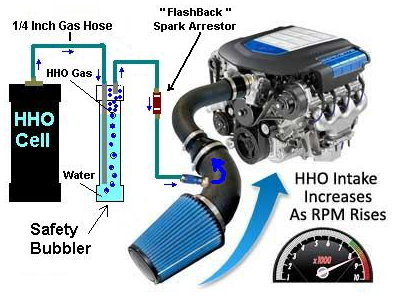
Flashback arrestors are used to keep engine backfires from igniting whatever oxy-hydrogen gas is in the lines and the booster.
Arrestors keep burning gases from blowing through the tube. The three basic types are the valve-type (which uses suddenly increased air pressure in the tube to close a one-way valve); filter-types (some use bronze wool and others use permeable stone); and water bubblers. Home-made valve-type arrestors can be a bit difficult to calibrate, so if you’re going with a valve, you’d be safer just buying one.
For more info, do a google search on “hho Flashback arrestors”
GENERAL
1. Do not discard or remove any of the old gasoline setup components, e.g. tank, carb/FI, catalytic converter, unless necessary. Better to always leave an easy way to revert back to something that at least runs, just in case. Some people are leaving their gasoline setup completely intact, and switching back and forth at will, just to have a backup plan.
2. Set your throttle circuit so that you get minimum vapor flow at idle, and maximum vapor flow at full power without blowing the pressure relief valve. In this way, you control how ‘lean’ your mixture is by the strength of the pulse (i.e. “fatness” at the optimum pulse frequency).
3. If you just don’t get enough power (at any throttle setting), it means that you need to (1) change the pulse frequency, (2) change the gap between the electrodes, (3) change the size (bigger) electrodes, or (4) make a higher output pulse voltage (last resort). Always use an output transistor, such as a MOSFET, that is rated for the voltage and current you need to get the job done. OK so you might have to play around with it some. Isn’t that where all the Fun is anyhow?
4. If you get any engine knock our loud combustions (not compensated by adjusting the timing), it means that you need to install an additional coil in the chamber, and drive the coil with an additional pulse signal (about 19 Hz on the .1sec time base). Here, you will be slowing down the burn rate just enough so that the vapors burn thru out the power stroke of the piston. Be sure to include a board-mount POT to set the correct strength of this 2nd pulse signal into the coil. This is a stainless steel coil of about 1500 turns (thin wire) that you can arrange like a donut around the center pipe (but NOT touching either electrode), directly over the circular 1-5mm gap. You want no knocking at any power/throttle setting; smooth power only, but also no excess hydrogen leftover from the combustion.
5. Build the canister(s) as tall as you can without compromising your ability to mount them conveniently near the dash panel, or in the engine compartment, as the case may be. This way, you can always make the electrodes bigger, if necessary without undue hardship. Remember that anything in the engine compartment should be mounted in a bullet-proof, vibration and temperature tolerant fashion.
6. If you have to drill a thru-hole for wiring or plumbing thru metal, make sure to also install a grommet for protection against chafing. Always watch your chamber pressure range from IDLE (15-25 psi) – FULL POWER (30-60 psi). Set your safety-pressure relief-valve to 75 psi and make sure it’s rated for much higher.
7. Shut OFF the power switch and pull over if there is any malfunction of the system. Your engine will last longest when it still develops FULL POWER+ at some minimum temperature that we are sure you can find, by leaning back the Royal Vapor Flow and/or by making use of the water-vapor cooling technique. Keep good mpg performance records, and periodic maintenance/inspection. Keep it clean; save some money; clean the air; heal the planet; happy motoring; tell a friend; enjoy your freedom and self-empowerment.
8. There lacks documented material for perfecting this vapor system thru a fuel injector; there may be some details you will discover on your own as working prototypes progress. For example, you may be restricted to inject the hydrogen/oxygen vapor without any water vapor, as it may rust the injectors. If engine temp and CHT is a problem, then you will want to re-think your plan, e.g. ceramic-coating the injectors. There is always “replacing the FI system with a Carb.”
9. If you install the water-vapor system (for lower operating temp/stress), you will want to lean the mixture (vapor/air) for minimum vapor flow rate to achieve any given throttle position (idle – max). Make sure that you get a minimum flow for IDLE and a modestly sufficient flow for MAX, that does the cooling job without killing the combustion.
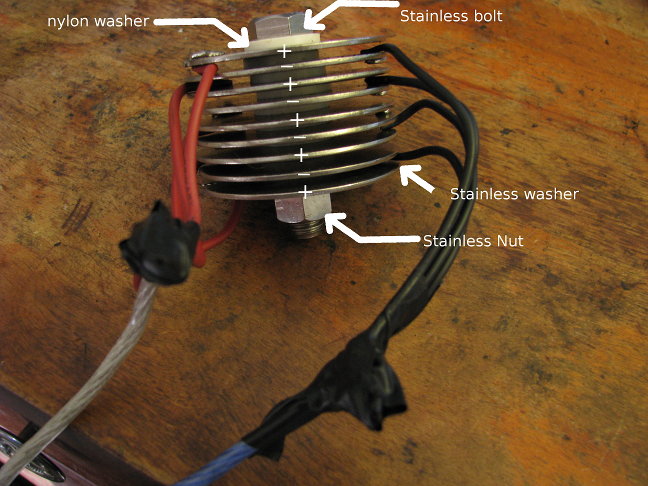
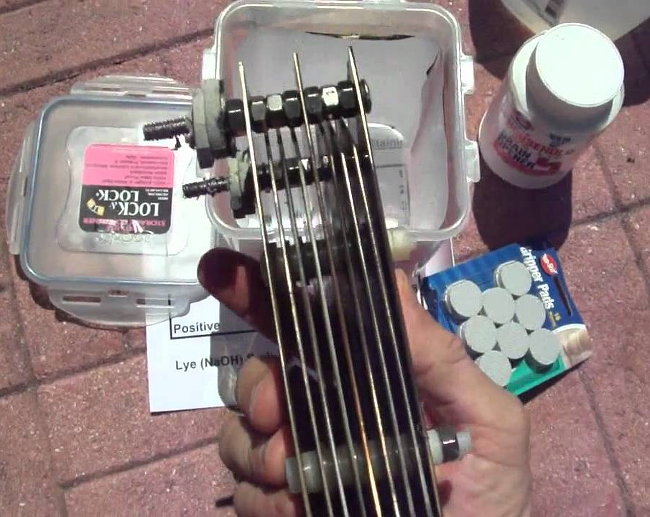
10. If you cannot find stainless steel pipe combinations that yield the 1-5mm gap, you can always regress back to alternating plates of +/- electrodes.
11. If you are concerned about the water freezing in your system, you can (a) add some 98% isopropyl alcohol and re-adjust the pulse frequency accordingly; or (b) install some electric heating coils.
HHOi under pressure into fuel rail may be the key to running vehicles on water and air
The onboard electrolysis unit, powered by the vehicle’s battery/alternator, produces an ionized hydroxy gas [HHOi] (the hydrogen and oxygen are not separated) that is injected under pressure (30 – 60 psi) into the fuel rail, and is able to keep the engine running.
The longest Rick has kept his Jeep going like this so far has been around 2.5 hours before it died. During that time, Rick was able to rev the engine via the accelerator pedal up and down, including to 3,000 rpms. It didn’t ever backfire. Somehow the car’s computer is able to compensate for the different fuel, and increase and decrease the speed the engine runs in response to the changing pedal position, just as it would if gasoline were running the vehicle. Perhaps the variation in airflow with the varying throttle positions with the pedal changes is what regulates the engine speed in this case. Also, the Jeep computer’s knock sensor automatically adjusts the timing of the engine to handle the HHOi gas. Rick was amazed to watch his gauge show the timing change on his Jeep.
The odd thing is that the rate of hydroxy gas production was constant, and was not governed to correspond to the increase or decrease in engine load. Nor is the rate of water consumption at a rate that present physics would predict would be needed for the water to be serving as fuel. Nor is the rate of electrical consumption in producing the hydroxy gas proportional to the amount of power manifest in idling the vehicle for that long. One of the pioneer researchers in the field, George Wiseman, points out that to be practical, the Brown’s gas (HHO or hydroxy) production will need to be nominally in proportion to the load requirement.
These attributes are similar to what Freddy reported, except he allegedly was running his friend’s pickup truck under load – driving down the road, speeding up and slowing down. Rick hopes to get to that point some time this week, with the help of an associate who is flying in to help out. If they get it running well, Rick would like to drive down to where I live and show it off to me.
… the hydroxy gas that both Freddy and Rick are allegedly producing is being called “HHOi”, the “i” symbolizing “ionized.” This is a term that James Sharp coined, and which Freddy has picked up
…Ionized Air as Fuel Contributor
On Saturday morning, Rick called me up to report that he tried running just straight air with an air compressor into the fuel rail on his Jeep, and that it actually idled for 2-3 minutes that way. He was wondering if whatever leftover fuel that is in the system might be enough to enable it to run that long.
Because of some other situations I know of, I postulated that it may be that the pressurized air itself could be contributing to the fuel component — with petrol in this case, and with HHOi in the above set-up.
I know of another researcher who claims that several years ago he was able to get his car to run on air alone after getting above 15 mph — that the pressure of the incoming air was enough, and there was enough energy in the air from solar power ionizing molecules in the air, and his engine had enough of a combustion efficiency to actually utilize the air as fuel under that low pressure and flow. He temporarily abandoned this effect to first pursue something not so disruptive and difficult for people to believe.
This week I got a phone call from another researcher, this one saying that he got his Papp engine running, and that the fuel source is . . . air. He doesn’t want coverage yet, but we are in process of checking out his claim, as he invited us to come see it. The reason I feel compelled to mention it here is that the Papp engine process may be similar to the effect we’re discussing here.
pesn.com/2010/09/27/9501707_HHOi_under_pressure_into_fuel_rail_running_vehicles_on_water_and_air/
REFERENCES
*Stephen Chambers ‘Apparatus for Producing Orthohydrogen and/or
*Parahydrogen’ US Patent 6126794, uspto.gov
*Stanley Meyer ‘Method for the Production of a Fuel Gas’ US Patent 4936961, uspto.gov
*Creative Science & Research, ‘Fuel From Water’, fuelless.com
*Carl Cella “A Water-Fuelled Car” Nexus Magazine Oct-Nov 1996
*Peter Lindemann “Where in the World is All the Free Energy”, free-energy.cc
*George Wiseman “The Gas-Saver and HyCO Series” eagle-research.com
*C. Michael Holler “The Dromedary Newsletter” and “SuperCarb Techniques”
*Stephen Chambers “Prototype Vapor Fuel System” xogen.com
Daniel Dingel
He has been running his car on 100% hydrogen
(hydrogen from water) for 30 years (?!)
He has never tried any mixture of gas and water – he does not think it is possible. His car consumes about 1 quart (liter) per hour, he says. Conservatively 1 gal. should take you 120 to 240 miles? (30 to 60 mph) That makes water a lot better than gasoline on volume alone, not to mention price!
He is said to have converted 100 cars to run on water.
Ronn Motors, Dennis Klein, Francisco Pacheco, Stanley Meyer, Daniel Dingel and others have all done it with their designs
see our page, The history of Water Powered Cars
With Daniel’s death, it comes out that, rather than give it to the world freely, he got frustrated (?) and took a buy-out, giving his car and hho generator to a friend, Pete, to publicize after his death.
See our page on Daniel Dingel 1968
or his friend’s site at www.dinglefoundation.com/hhoblog
A.K.A. Pulse Width Modulator
- Dave Lawton

We have not checked it out beyond the home page, but the panacea-bocaf.org
web site seems to be trying also to freely provide information on how to build your own – or pay as little as possible – for a hydrogen generator.
many more videos:
UTube videos on building your own water to hydrogen generator / HHO Water Fuel
Other Options:
Magnetism:
There, finally, seems to be some significant progress toward powering a generator with a magnet motor. This goes a long way toward reducing the amount of battery storage needed to power an electric motor/vehicle.
see A Few Magnet Motors
Vaporization:
“During our interview the eager young inventor revealed how he had discovered his fuel system by accident; “I was messing around with a lawn-mower when I accidentally knocked a hole in its fuel tank. I put a vacuum line running from the tank straight into the carburetor inlet (he removed the carburetor). I just let it run and it kept running and running but the fuel level stayed the same. I got excited. The lawn-mower was running without a carburetor and getting tremendous efficiency.”
see Tom Ogle carb.
The Nelson Pogue carburetor caused a sell-off of oil stocks in 1936.
9-14-2012
We cannot tell how much it will help, If Daniel Dingel‘s HHO system is easier or not, but upon his death, he instructed a friend, Pete, to post how to make his generator.
See our page: Daniel Dingel 1968
or his friend’s site at www.dinglefoundation.com/hhoblog
1935 – Inventor Henry Garrett patented a electrolytic carburetor and let a car run on tap water.
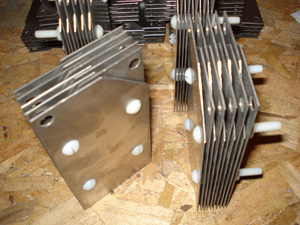
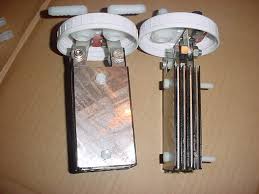
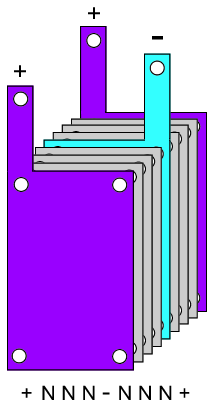
plates of stainless steel placed in either flat or concentric arrangements. (see the washers, on the right, for the simplest method) Gas production seems to vary as the inverse of the distance between them; the patents suggest a spacing of 1.5 mm produces satisfactory results.
Having done some research on the control circuit , I am having trouble finding some of the components; the MOSFET and MOSFET Driver, and the CD4069.
Do you know where I could find these components?
P.S. I found references to “Digi-Key” Thats were I’m getting most of my other components that I don’t have right now.
Jeff Schrader
Someone was looking for the TC4420′s. They can actually be gotten straight from “microchip” (www.microchip.com) as a free sample
- Shawn Moore
I was wondering if you had detailed plans to create the circuits (part number, component names and reference numbers as i am really interested to build a few of theses units.
Thanks to take the time to reply to this request.
The info. is all being put on this page. -ed.
How can I get the plans and diagrams to build the hydrogen generator? – Clark Ladner
The info. is all being put on this page. -ed.
…
2012-09-18
PS You might ask Daniel Dingel’s friend, Pete.
Great site! This diagram you sent me is almost the same as the D14.PDF file, simply the components are arranged differently, so it looks different.
Also, my website PWMPOWER.COM gets about 1.2 Million visitors a week, so we are VERY busy in the ship. Now we do not charge until the PWMs ship, so the only complaint [we] should get is “they take too long” which is true when you have over 100+ orders waiting to be built, and only 7 guys in the shop building them.
Thank you for the email.
Dave Lawton
P.S. There is a very simple way to doing this WHOLE water powered sysem on 0.5Amp!
the D14.PDF file can be found all over the internet. -editor
Dear editor,
please advise me, in indonesia I can’t find IFR 510 and TC4420CPA, could you give me solution another component or something that could work likely IFR 510 and TC4420CPA
Regards
Johnny
Love the content of your website, so it’s cool. “Simply amazing,” is all I could say. What is even more dumbfounding is that this technology is resurfacing today.
Sincerely,
Kenneth Segovia
I would like to enquiry the hydrogen engine system can use for the car. How much is cost for per of unit.
Cos I am in Vietnam, haven’t got all the things you have – I do not know how to set up. If it possible, we can ship to Vietnam in 40ft container of your product. I look forward to your advice. Thank you.
Kind regards, Michael Pham
This is a “build it yourself” project, not an unknown product for sale. Hope you can get the parts over there, or order them. – Editor
I’ve been watching with keen interest, the progress of these hydrogen devices Sounds to me like we are on the brink of an energy revolution, and I do not want to wait much longer to participate in this revolution. I have several friends that are interested in the same technology. I would appreciate any information that you could provide.
Many thanks,
Ronald J. Joachim
Ron,
Our whole page here is about passing on to you all the information we can come up with. Wish us both luck. … Agreed. We all need it asap!
EX: today there was a news item on the channel 10 Miami TV station telling of a guy in business installing them – can’t get a response from the TV station.
i will be very thankful if u give me some information. i have seen a diagram of hydroegn convertor in ur website. can u tell me; will it work with baking soda or without? also if u send me more detailed diagrams with easy instructions i will be very thankful to u.
kashif
Everything is on this page. – ed.
I would first like to say I am extremely glad to find all the information and links you good Ameicans post for use by ‘We the People’. Thank you for taking a stand. I support your cause 100% and would like to see a working group form in my area. I am working to build an HHO generator to power a V-8 truck. Can anyone tell me, approximately, what the HHO supply requirements for a say 350 cubic inch engine is? It of course would be extremely helpfull to know idle through say 4,000 RPM.
Eric J.
Pensacola, FL
Eric,
From the information here on Daniel Dingle, Denny Klein, and others, it is clear that it varies. Some designs are more efficient than others.
It will be good to see photos and results from a few who have built them – ed.
i don t know if this would be a reason why daniel dingel may have not used ceramic in the engine but he says the gas must be cooled before going to the combustion chamber. when he was not yet using a -bubbler-(maybe or any system for the purpose), the engine was getting damaged.
I am unaware of his saying gas “must be cooled before going to the combustion chamber”. Most, if not all, say engines run cooler with water, hydrogen, added. The exaust, coming out, is cooler. I did discover a note that he did have a problem with rust at first, but he overcame it.
-editor
see the page on Daniel Dingel
firstly i like this and plan on using this idea when i build me a dunebuggy…..thnx for the info, and ill post as i need help or have a running vehicle … keep up the good work … could use some photos on the build step by step.
We are dependant on readers like you for your photos. Please submit them.
However, if you are building a dune buggy, why not put in an electric motor and only the few needed batteries. You won’t need to go 200+ miles like in a Tesla Roadster, right? — However, if you have an extra gasoline engine sitting around, might as well try it!! Good luck!
-editor
Thank you for this site. Do you know if there is someone in Hawaii in particular in Honolulu that has done the retrofit or is currently working on one?
I would like to contact them to see if I can work with them.
Thank you
Don’t know of anyone. Anyone from Honolulu out there? -editor
I went through your website it caught my eyes that you are running your car on 100% on hydrogen, nice to know that, I want to know how you manage to inject hydrogen into the engine, and what units are applied, kindly let me know about this please cause I’m trying to make one for my self.
Very thanks to you,
V.Prakash
Thanks. There are easy / cheap ways to tap into the intake. Think there is a video on one. Check YouTube. We will try to find and add one here. -editor
There are increasingly more on board hydrogen systems available out there. I bought one for too much money and still haven’t been able to get much in fuel savings but I haven’t given up. My problem now is hydrogen production. The electrolyte method is inconsistent and seems to need a lot of maintenance. I’m going to start thinking about the pulse method and try to implement it on my current system.
Keep the faith and fight the good fight.
Dan
I am very interested in this and would like to try building one myself but one you do not have a material list that i could find, second could you make this a download pdf for us to print out and have the diagrams on hand during the build. other than that very nice site and design ty.
Everyone should rt. click to view and download or print the diagrams, and also “cut and paste” the text they want into a file and, perhaps, print that also. Thank you for mentioning it. -editor
Dear Sir
I have been working on Hydrogen gas engines for a number of years. yet we all know now that it is a very efficient way to run an engine of any size. and it is sort of becoming more accepted within the general public. One would think. The proof is out there that it works. Yet I am having great difficulty in getting a University and an Inverness Councillor to believe that it works. You see I have designed a rotary engine that I believe is far more efficient that the common four stroke. ie less moving parts, less fuel, less resistance. More power for less of everything including cost. its much cheaper to buy and to run. I need someone to actually build one for me so that I can prove that it does what it says it does. Though they can see it they still don’t believe it WHY. I would appreciate your reply. to
kentcip [at] yahoo.co.uk
all the best
Kenneth R Taylor
Project Design Engineer
I admit that I thought “water-powered cars” was a myth, a joke, till I started reading seriously about it. Most people still do. They don’t know about Ronn Motors, Dennis Klein, Francisco Pacheco, Stanley Meyer, and Daniel Dingel.
Your invention is another subject. You need to find a custom machine shop. Someone who can build a simple, crude(?), small(?), prototype for a price you can afford. One that would power a motor cycle or a go-cart. … one that will prove your claims … and convert the disbelievers.
-editor
Everything has me excited, I went thru my inventory of old cars, and my 1987 Toyota Tercel appears to be my future hydrogen car,(good running car) of course everything in moderation, I like everything spelled out on the drawing board, but when reality sets in, usually, after the final shop drawings are complete, I am ready to see how the hydrogen generator will work on my car, I think your explanation on how this system works on a car, seems precise, right on the button. If my results would fail, it would be because of my anxiety, therefore, I wish to go thru a calm filtering process where I don’t have so many irons in the fire. I will try to first try a small step, by taking a seringe and entering it into the air hose, I know that is not the formula, But I will try by using a small ratio proportion to your design, and step up the formula as needed, success to you sir.
Good luck, and keep us posted – editor
sir i need designing of electrolozor what type of metal to make i am india please give me detail
How about “whatever is cheap and easy to work with.” “Keep it simple.” Best Wishes -editor
Hello,
Im led to believe that on modern FI vehicles, the EGO sensor actually tries to correct the fuel mixture when injecting hydrogen gas, by injecting more fuel, as the hydogen burns cleaner, the ego is tricked to think that is
mixture is too lean. Is there some way to over come this?
I would like to become a member of a group. Please reply.
Thank you. Bob
Bob, It does appear that we may have a group forming here. You, Shanthrajk maybe, John, Kenneth, Keith, Dan, Vijendra, Darren, Calvin maybe, … and others. If everyone will report their progress along the way. We may have something.
- editor
From my experience, Para-hydrogen will not produce results. It has to be Orth-hydrogen, produced by a Pulse Width Modulator. Also I am having trouble with “cold steam” water vapor. I suspect the hydroge/oxygen molecule is getting back together soon after it is split in the electrolyzer??? Need to use that Egas right away!
Yes, what we are generating here are fine-tuned pulses – matched to the frequency of the water molecule. The further off from the required frequency one gets, the more energy it will require, and the more futile it will get. …
- editor
PS : If you have photos to share, we will display them here with your notes on them.
Also, these are chemical reactions, hydrogen is hydrogen. Good grief, don’t get distracted. Good news, if the hydrogen-oxygen were recombining in your container, the container would explode!
I find your work in hfc to be very interesting and I am going to attempt to build one . Is there anything I should know?
what kind of oscilliscope and how cheap can i get one?
Hi Rob,
I just purchased an oscilliscope from Madell Corp. $288.83 includes shipping. It has duel trace. ref. number 0A0A3414-4B9AECF1-223-5FED2 It should be here in a week.
Bob
OK, I would like to start my fuel cell project. I don’t claim to be a pioneer as they have arrows in their backs! I like to read about others projects and try to take what seems to be the best route, then make my own modifications. After reading for about a month I would like to start my fuel cell project and Dave Lawton project looks promising. One problem is I can’t find any clear materials to make my fuel cell out of. Isn’t it important to be able to see what is going on inside? Also there are a number of people that would like to sell you books about these fuel cells, but I can’t find any information on them, and can’t communicate with them. Has anyone gone that route and how did you make out? Thanks!
Bob
use a glass jar? …
This all looks very easy to build, I do have one question; that is the spacing for the generator. What is used for this? Will a plastic washer or rubber work for the spacing? Thanks
Yes, from some of the videos, I think you can see both plastic and rubber being used. -editor
During combustion of the engine hydrogen molecule will join with oxygen molecule to form water…….wont this have a reaction on the walls of the engine?
Water is a by-product and so the exhaust system is more of an issue and mentioned above. Daniel Dingel is the one person who has been running his car almost totally on water – for 30 years(!) and I did discover a note that he did have a problem with rust at first, but he overcame it. He used gas to start the car and then again for a moment before turning it off. See the page on Daniel Dingel
Note: Bruce Crower is adding steam, not just hydrogen, to his modified engine and he also solved the problem easily – more or less, the same way. See the article on his Steam-O-Lene engine
-editor
Dear friends,
I have been reading your articles with great interest, can any of you pls. tell me if you have finished building a hho generator and if it is actually saving fuel.
Best Regards,
Gormur
Hi thanks for all your work. I built a simple generator whilst in Canada using stainless pan scourers for cathode and anode. Used mother in laws preserve jars for generator and bubbler, I had a p.w.m. from the uk, it worked great on an old VW tdi Jetta, I drove from south Ontario to the north on 1/4 tank,I posted the info on another site how to make it and received letters telling me its not possible due to this law and that, when I left 6 months later it was still working great.
Hi, I have built a dry cell but have one problem. It will not cycle up through the resevoir and back down into the cell as it should. It instead expels hydrogen out of both the top and bottom hoses and fills the reservoir, therefore leaving the the cell dry. I have moved the reservoir higher and the base is now 20cm above the top of the cell. This cell is producing plenty of hydrogen at 13amps using KOH. A small amount of foam can be seen on the top of the water in the reservior also. Any comments or advice would be greatly appreciated. Regards Lindsay in OZ.
What is a good price to pay for PWM.
Do I have to say its for a 12 volt DC system.
dear editor,
I have been interested in hydrogen powered vehicles for a number of years now. I like all the info on your site, and have some more to help some of your readers… I happened upon this site a few years ago, and have referenced it often: http://freeenergynews.com/Directory/WaterFuel/Cella/
I have built a few small generators already, and am slowly gathering parts to build one to completely power my car.
My only problem is that I have not been able to source information regarding how to introduce the hydrogen into the fuel injection/carburetor other than using a propane mixer as shown in the site that I mentioned. If anyone has this info, I would be very appreciative of any info regarding this
Thank you, Ralf
You are welcome. We saw the site you referenced some years ago and it is good that he is telling what he learned and did for free, but it still seems more complicated than the information we gathered here from other sources. There is information here about getting it into the combustion chamber.
Anyone interested might look at Cella’s information for more ideas.
-editor
I built the circuit and I am using a power supply that I cannibalized out of an old computer (which works perfect if you don’t have access to a real one!). I am using 12VDC for the main power and the 5VDC for the throttle input to simulate the engine’s throttle position sensor. This is run through the 100k pot. Is this right? I am generating a small amount of gas but for some reason the throttle is not controlling the duty cycle of the waves. I have the throttle signal going to pin 3 of the amplifier as in the diagram above. Does anybody have any ideas? Everthing else seems to be working OK so I must have something wrong at the throttle.
I will attempt the project on a vision of renewable energy but it would be nice if there were more people stating their success. Also I would like to know how to contact Mr. Daniel Dingel as I will be in the Philippines later this year.
I would like to finish off with a quote from Einstein himself “The true sign of intelligence is not knowledge but imagination.”
Thank you,
JDDD
Mr. Dingel lives in the Manilla area. take a look at our page on him and his invention as I believe it was even mentioned what area of the city he is from. I hope you get lucky – and can report back to us what you learn! -editor
I have seen and read numerous articles on this subject using this concept and like to find someone or a company that would sell me several kits for my vehicles including my motorcycle. I can build the “generator canister” made out of electrical stainless wall plates myself, using a used automotive 12 volt coil from 20,000-80,000 volts,a solinoid for primary voltage to turn it on and a 0-16 volt,5 amp.rating rotary pot. I have built a higher current one that worked off a vacuum line – it wasn’t worth the effort!! It didn’t work that great.
thank you
tom duffy
Hmm…I am positive your on the correct path. Everything is about the harmonization of frequencies, just as Telsa and all the great ones always knew, and that time iself only exists because we our ownselves are locked in step with a frequecy, just as the water is itself composed of vibrations which bond it together. So forgive me for saying this, but if time ends as the Mayans supposedly said it will, then, perhaps in this quest we will free our own selves from the slavery of time as we understand it. I have no doubt that Stanley Meyers was murdered. Only in the destruction of the masters by free exposure to the secrets of what Meyers uncovered will our own world be saved. We see now the oil volcano, and Goldman Sachs making billions off of bidding against BP. Yet again, we are asked to believe that no conspiracies exist, but where is justice, and where is the govcorp which still proclaims it belongs to us all? If Goldman Sachs stands to now own BP at a profit of 33 billion, then, Stanley was to be had on the cheap, which is just their style.
i think this is briliant
Hi, I’m Italian and of course my English is not so good. Anyway I really would like to convert my car into water, but I’d like to see very simple plans that everybody could build in a easy way. I still haven’t found it on the internet. Where it is possible to find it?
We keep looking, and put the best we have found right here. Some of our visitors comments are very helpful also. -ed.
Hello. I’m from Israel. I mounted it fine. Thank you – but without the coil input current 6A. My next step – to mount the coil between the pulse generator and tubes. The coil is made of ferrite rod (length-8″, diameter-3/8″) and bifilar 21AWG 100 turns.
Thank you again
Hi
In first place thank you for the information you give on HOH
I was wondering if you could respond to this question if you know the answer,
I would like to put a electric generator running only on hydrogen
I also thought on putting a second bubbler but instead of water I think that maybe with gasoline, oil or oil misted with gasoline.
Thank you
Rui
running on hydrogen and running on gasoline vapor is 2 different things. The 2nd is called a super-carburetor.
For example Tom Ogle said “I was messing around with a lawn-mower when I accidentally knocked a hole in its fuel tank. I put a vacuum line running from the tank straight into the carburetor inlet. I just let it run and it kept running and running but the fuel level stayed the same. I got excited. The lawn-mower was running without a carburetor and getting tremendous efficiency.” Read our Super Carburetor pages if you are interested in that.
-editor
Is it possible that no one in the whole world was able to put a valid document on the internet on how to build a working generator and be able to finally start a car’s engine on it??! It’s been 10 years since they murdered Stanley! Come on!! I’m getting tired of all this guessing, someone heard this, someone heard that stories!! 10 years!!
I mean those of you who succeeded in doing it know that you can NOT make money on “your” “invention”. You can only get a bullet in your head for that.. So please make available the data for the sake of the world!
We could not agree more! What we have posted here is the best we have been able to find, and it is not good enough…
A super-carburetor is another approach, which should be easier, (see Tom Ogle or John Weston) but seems even more complicated, unfortunately. … either one could be accomplished by Detroit easily – if they were not “in bed” with the oil co.’s and everyone else maintaining the “status quo”$! But, for us, not quite so easy. … and no one wants to talk, but … see Ronn Motors, Dennis Klein, Francisco Pacheco, Stanley Meyer, and Daniel Dingel.
-ed
Question. When I am generating my hydrogen gas in my canister and I add water, I think tap water is best, as the dissolved particles and the ions will conduct the most electricity. My questions is this: Should I dissolve NaOH in the water, or is that more problems than I would want (along with it being rather dangerous)?
Tap water has been mentioned enough times, don’t bother. It’s not necessary. -ed
I had a question?
Is what you’re describing meant for a mix of hho and gasoline, or is it meant to be solely hydrogen?
I have built a hydrogen generator and installed it on my truck and appears to be working fine except for one problem. The difference in temperature between the generator tank and the bubbler tank while cooling overnight creates a suction or siphon affect and draws the water from the bubbler into the generator which causes a whole host of other problems. I feel the solution would be to install a check valve inline between the two, but I cannot find anything suitable. I have 1/4″ vinyl tubing connecting them. I tried the medical supply trade as well as the hardware and automotive stores.
Could you offer any suggestions, if so will be greatly appreciated.
we did a google search on “buy a check valve for 1/4″ vinyl tubing” and got of sources for pools and aquariums. Hope you found a good one.
I am installing the HHO generators on my RV. It has a dodge 440-3. I have plenty of room for the jars, and everything. I even moved the battery over to below the steering column, so I have even more room. Here is my issue. I installed an inline fuse between the battery positive and the jar at the hydrogen collection point, and the negative to the other side of the jar. I put a 25 amp fuse in, and connected it. BAM, blew the fuse. Instantly. It did that to two more fuses. So, I stopped. What should I do now? I tried it without the fuse, and melted the wires in about 10 seconds.
Thanks,
Bill
It does sound like something very simple. . . . anyone?
Hey Bill,
Sounds like a dead short in your generator. Do you have any other electronics on it like a high frequency generator?
The first thing I would recommend is drainning the water, then maybe even rinse the generator with plain water for good measure. If it still blows the fuse when empty and dry, chances are that the plates are touching somewhere.
Do you know anyone with electrical skills that can help? Anyone that works on cars, air conditioning equip or refrigeration?
Good Luck
Was just kinda wondering if anyone has looked into the btu that would be needed to apply this to home heating and if it would be feasable. I’m a master electrician with a wide construction backround and this has caught my eye… you guys are headed in the right direction. Keep up the good work
Yes, It should be easily doable. For instance, any gasoline powered home generator could be converted to on-demand hydrogen. It is only that transportation is the big, environmentally most destructive, application right now.
However, if that seems easier to you, personally, than dealing with your car/vehicle, then, Yes, try that first. Go for it!
-ed
Hi,
I’ve spent last 4 years round hydrogen in vehicles. However, I’ve been boosting existing engines (not 100% hydrogen) Diesels benefit more from supplemental hydrogen and have less technical issues. Fuel economy is increased by between 20-30% and emissions are halved. The engine runs smoother and the improvement in performance is noticeable. There are also another few names that managed 100% water powered: Hermann P Anderson (US) Greg Vezina (Can) Steve Ryan (NZ) and a few others before that. However, I believe that it will be a while before 100% hho is available to the ordinary guy and I’m concentrating on improvements to the existing engines. There’s another retrofit available (actually easier to fit and cheaper) that achieves almost the same results as boosting with hho. It’s where exhaust waste heat is used to break water into a hydrogen rich plasma which boosts the primary fuel burn. (similar to Paul Pantones GEET) We’re testing units right now and results so far are very good.
If anyone is trying to boost with hho, I’m happy to share what I’ve learnt (where my time permits) but I would also urge caution where people are building their own units and diy fitting without the basic precautions. The gas you are making is highly explosive – c. 8,000 ft per sec – that’s why only a small amount is needed to boost an engine. As I understand it, ortho hydrogen should not be compressed above 15 psi, it’s been known to auto ignite when it degrades to para hydrogen. The other safety issue is make sure that your electrolyzer only has power when the engine is running, or you could have a buildup of gas.
It’s happening, just a lot slower than a lot of us would like. But the more people that know about the alternatives, the better the chances of it happening. As history will attest, the technical aspects have always been the easy part, it’s the political and financial part that are the real hurdles.
To correct the oxygen sensor problem, raise the sensor out of
the exhaust flow, there are extension fittings available on the market, that do just that. Have not personally tried them however.
You have done a great job by publishing these ideas.
I am going to do this project can you help in saying of the disadvantages this project?
Can you give me details in more depth so that i can do this project as my professor said that this project cannot be done and he asking for safety aspects , pressures of the system , patent etc .
hi guyz awesome info page you have here. i am currently using a coil type generator made from a glass jar which has stainless steel wire coiled around a support attached to the jar lid. I’m not intending to run the car of 100 percent hydrogen just yet but i was wondering if i could use this frequency pulse system just to boost the hydrogen output on the coil setup i already have installed. any info would be great thanks
I like to have one here in Nigeria when you go selling and I will be you reseller. If you have information electrical generator without fuel please get to me. 234802302xxxx
I am sure you have seen many web sites selling HHO generators “for a price”. You can buy and re-sell any of them you like, if they work. I haven’t seen any I trust.
If you are in or near a city, you should (I hope) be able to buy and / or make these parts – cheap. That is the point of this page. It is good to read a few of the comments from others who are accomplishing it below.
An alternative, if interested, is to read about super carburetors – especially about Tom Ogle and John Weston.
Good luck!
I need help building something like these examples. I live in South America and I have more unsupervised space and freedom to make something efficient and market it. Not so much to make money but rather to flood the market so the oil companies are literally pissed on without the source or knowing who pissed on them. That is sweet victory for us and for our planet. Let me know who can and wants to help. I can follow the schematics as you explain them and I learn most things first time around but I want to really get a collaborated effort if possible. Thanks
what about winter? wont the water freeze?
Read about the Gulf and Saudi Arabia .. I think you can come up with something.
-ed
I have been playing with generators for a few years now and had a fair one working a couple of years ago it produced around 1.5 to 2 liters per min. I used baking soda and had to run the amperage pretty high 2 cells at 20 amps each to get 2 liters. I am now building my next one and plan to use a PWM I may build my own but have ordered one for 25.00 off Ebay to try it out. They say it is adjustable for pulse width but fixed at 30,000 hz and capable of 20 amps at 70% duty cycle indefinately,
I have also ordered an EFIE unit since the one I built worked some and sometimes I got 57 MPG out of a 4cyl 4WD jeep and other times the computer figured out I was doing something and dumped gas net result at times I got 15 MPG I’m hoping the manufactured EFIE will be more consistant. I just put the generator together and already think I got the plate spacing so large they ended up around 1/4 inch and should be 1.5 to 2 mm or about .06 to .08 inches so I may redo the plates before I hook it up. But I may try it as it is first and even try KOH to help. I’ll post the results.
I am a 14 year old that has built a hydrogen booster and I am greatly interested in building and selling cars that I have converted to run on hydrogen please help me if you can I am open to all suggestions.
I tested the 1/4 inch spacing generator today it was disappointing my PWM hasn’t come yet but under 12volt direct current at about 30 to 40 amps it only produced 1/2 liter a min. I did hook up my second try at a plate arrangement spaced at about 1.5 to 2 mm not in a sealed generator but in a bucket and it put off a fair amount of gas it seems, in plain tap water and at about 25 to 30 amps I am going to install it in a housing and measure its output and as soon as the PWM shows up I’ll try it with the power wave modulator to check for any advantage in production and drop in required amp input.
Hi, I am interested in selling a new unused hydrogen fuel conversion kit. I know absolutely nothing about this thing except that my husband purchased it, paying 756.00 dollars for it and now due to personal reasons will not ever be able to do anything with it. Can you direct me in where or how to go about getting in touch with persons that might be interested in buying this from me? I have the receipt and all of the paperwork that came with it also, and specific instructions per the distributor as well. It is an AquaTunePlus with container (+$92) as shown at aquatune . com / aquatuneplus.html
I would gratefully sell it asap for 300.00 and I will eat the shipping cost. I can be reached at michelle5289 *.at.* verizon.net or you can text me at 903-259-7690. I would appreciate privacy with the number in that I am texted before called. Thank you for any help you can give,
Michelle
In figure 2 Block Diagram it shows the electrodes at the bottom of the chamber. Yet other pics show it at the top. Which is correct? I plan to build one soon and want to do it correctly.
Thanks, Bob
whichever is easier for you. Keep it simple.
These are some great articles and inspiring me to read more on the subject and perhaps try to make a HHO boost generator. How do I get in touch with others who posted comments? Paul Little mentioned to get in touch with him but I see no way on this page other than leaving comments.
If you have a question, this is the best place for it, where anyone can see and respond, and if you have experiences to share, we all want to know.
Hi, i have been working on hydrigen, and i come up, with idea to make a car go 100% on hydrigen, and also, power generators, so i will post up news in 2 weeks or so how am i going ! :)
Great. Take pictures; keep us posted!
Hi I don’t know much about this thech but i made one fuel cell and will install it on my 460for class c and see what happen and I will start taking picture bye Louis
Great. Take notes, pictures; keep us posted!
For people who know nothing about electronics such as myself, is their a solution for people to just buy a kit from a trusted source and to then pay an auto electrician to fit it?
THe more I learn about how this stuff works the more I feel incompetent to make my own.
If Stanley Myer can make a Hydrogen engine and the principle of splitting water into hydrogen is so simple, why can’t I find a kit ready to install? That is to say, a hydro kit that produces 100% fuel efficiency?
If anybody knows of a source who can build and fit a kit that makes 100% Hydrogen only then i’m happy to pay them any money to get it done!!!
Thanks
There are “run your car on water” advertizements all over the internet and I don’t trust any of them.
In any case, it seems that the PWM (pulse width modulator) is the key. If you know enough about them, then it should be “fairly” simple to build your own.
If not, then it may seem rather daunting. Right now, my thought is that the rest of us should send Frank Weston an email (instead of hydrogen vapors, his car runs on gasoline vapors -at over 400mpg!!) telling him of your situation and ask him what he would be willing to do to help. He has no money so we would need to pay him, like you said, for a kit or something, See the post about him: John Weston’s Car gets 400+ MPG, Running On Vapor
Doing research and came across your page and wanted to give you a pat on the back and a “atta boy” Great imformative site.
One thought that I would like to put in though to most of us that are reading and researching this, a car, especially a late model one is a incredibly complicated blend of mechanics and electronics. Some one that knew what he was doing would have to design a system for each individual car make and type to have it work properly. To try to jump into this with the idea of making your car run on water is a huge jump. Think of playing with lawn mowers, gas electric generators and working your way up. The first rocket didn’t go to the moon. I personally want to get my riding lawn mower converted over for the learning process. Water gets me the grass, might as well try to mow it.
Love the information! Thank you for your efforts! I plan on making my own soon. Working too much, just need the time.
I have everything to build my own, set up, I have tweaked a few things to fit my set-up. I will post back up if/when I get my truck tuning on water, I’m not going for water/gas mix just pure water. Thanks for the info it’s very useful, also if you goggle PDF.d14 and PDF.d9, there is alot of good info there as well.
Thanks
Richard
Everything I have seen was very good. Thanks
How does this device (Meyer cell) get around the first and second laws of thermodynamics?
How does a tuning fork shatter a glass … no heat at all. That certainly breaks the laws of thermodynamics. The point is, thermodynamics has nothing to do with it, it is a tuned frequency, “a 0.5 to 5 amp electrical pulse”. With a wine glass, it is sound, with liquids, an electrical pulse. Go back up and re-read it.
-ed
Can a 2008 Honda Fit be converted to run on water? will it work on this car?
Yes.
To learn more about others experiences, read our pages on
Hydrogen Powered Cars — The Francisco Pacheco Hydrogen Generator — Daniel Dingel, 1968 — Dennis Klein’s Gas Engine Water additive — Ronn Motors: Scorpion HHO super sportscar — Stanley Meyer’s water powered car
i am very interested in hydrogen fuel, i am planing to build a water fueled engine driving a generator for my home and i believe that this will work.. and i will be saving the environment at a free fuel and basically free electricity.
I have intalled a home made hydrogen maker on my truck, HOWEVER, the sensor on the truck does not “see” the extra hydrogen produced and therefore lean out the gas mixture, so the mileage remains the same. It needs to get a variable, or manual override on the sensor to the fuel injection to lean out the gas mixture to use the hydrogen and therefore improve milelage. It might work better on a carburetored engine where you can lean out the jets and use the hydrogen more efectively. Garibaldi out
sounds like you are missing a Throttle Control – or it is not working. (read about it above)
-ed
What keeps the water in the storage tank from freezing in Winter months?
You should have read this page. Read about the Gulf and Saudi Arabia .. I think you can come up with something.
-ed
Thank you for all the info, I am a bmw master tech, i have a 2001 750il, and built an 8 cell generator out of stainless metals and installed the unit in my trunk, ran the tube to the front of the car and made a Y connection from the intake manifold to the throttle boot to get as much hydrogen at idle and at full throttle as possible, I went from 26 mpg freeway with no ac running to 39.8 with ac on, and I travel a lot with my car, it has 205k miles on it and has never run better, i used to use premium fuel and now it runs great n regular with no ping or problems.
thumbs up for this article, by the way just a question, the ignition temperature of gasoline is 280°C and hydrogen is 500°C, will this affect the performance of the engine due to overheat? Thank you!
You don’t seem to have read the article, “runs cooler than it did with gasoline”.
It is also helpful to read the pages here on Daniel Dingel, Stanley Meyer, Dennis Klein, … etc.
Microwave ovens work very efficiently to boil water because the microwave frequency used is tuned to the precise frequency which is most energy efficient for the purpose of causing state change of water molecules from liquid to gas (water vapor). In the same way, the use of high voltage electricity at very low wattage/amperes is used in Stanley Meyer’s device for the purpose of causing molecular dissociation of hydrogen and oxygen in the H20 liquid water molecule. So I am starting to wonder if old microwave ovens can be taken apart, and the electron gun in there might be used and adapted so that microwave frequency can be set not for state change of water to water vapor, but for very low power and very high voltage, to cause molecular dissociation of hydrogen and oxygen in the liquid water. Or possibly a similar type of electron gun can be constructed of the precise capacity for this purpose. In that case we could set up an engine with water being fed into the pistons as water vapor, then dissociated in a split second and ignited by standard spark plugs.
I believe that unless U have A LOT OF TIME & MONEY 2 invest, it’s best 2 make your own hho generator(make SURE it’s installed properly) and gasoline vaporizer and if U have fuel injection why not disconnect the in-tank fuel pump so the computer won’t inject more fuel than is needed and will be wasted. Ask GOD 4 wisdom and knowledge in all things! Also google can be very helpful BUT only GOD knows EVERYTHING!
Hi, I am from sri lanka. I am very interested in hydrogen fuel. I am planing to build a water fueled engine driving a generator for my home and i believe that this will work.. and i will be saving the environment
but I think I want some technical knowledge i mean I cant understand the dip switch and oscillator can get more information about that sri lankan people don’t care other fuel
so i couldn’t find information’s if u like to help me please send me more information simply I am waiting for u
If u have any time to chat via internet or over the phone please contact me
my no +094 0754940889 or +094 0774304285
or nasanjaya at gmail.com
i am seeing your hho booster and pwm i think it is made for a large vehicle like cars. But can i use it in my bike?
It is a hero honda passion+ 100 cc bike. i was already used a hho generator but it was create lost of problem in my bike like
it was dead my battery after run 200 km, not give beater mileage so can u help me?
I am interesting with your project let me know every progress.
Thank you.
Best Regards
Eka W Jayawardaya
The electrical dissociation of hydrogen and oxygen and reburning them for energy is only about 65% efficient. There can be no improvement in combustion unless the engine’s timing is changed. Most gasoline IC engines can’t be changed to efficiently take advantage of the improvement in the phase 1 of the combustion process. So, overall combustion is not effectively improved. The mileage may be improved only if the energy for hydrogen/oxygen production is obtained for free.
I HAD A VOLVO 940 car run on patro 95. I wish to built a Hydrogen in order to cut fuel consomtion.
Any halp/
I am having opel corsa 1.4 petrol,with lpg kit,Now i want to run it on hydrogen that is my dream.
we need a reactor to be use in converting a diesel fueled generator, is safe to build a big reactor for this purpose?
@Wilco Wayne,
I have a couple of counter-arguments for you. First of all, even a 65% efficiency is better that the stated 15-30% efficiency of a gasoline combustion engine. Secondly, most all new cars come with VTEC, or “Variable Valve Timing and Lift Electronic Control,” which (with the proper ODB II [car computer] programming) is designed for optimum efficiency. The good news with that is that you can change the timing on your engine system to raise efficiency. Third, electricity can be obtained for much cheaper than the equivalent amount of gasoline (think solar panels, water generators, etc). Lastly, the emissions of a hydrogen combustion engine are more “environmentally friendly” than that of a gasoline combustion engine (water versus carbon dioxide AND water).
For the most efficient engine, one could use both a traditional combustion engine and a hydrogen combustion engine (the products of both reactions can be used AGAIN as reactants for the hydrogen engine).
-I’ll be making a proof-of-concept model this summer, I’ll link results + a more usable set of instructions.
- Commander Daniel Shepard
Hello all the info is and has been a lot of help. My plan is to put what money we don’t spend on gas and use it for our kids. There are more reasons than that; it’s the top one
I have ran many different types of cells over the past 6 years but all of them with Brut force. supplementing with the fuel in the vehicle the best I have done is on a 1995 Chevy truck I went from 18mpg to 42mpg with a four cell generator running at 30amp my water was mixed 1gal with a teaspoon of baking powder, hydrogen peroxide and rubbing alcohol. I am a true believer in the pwm and finding the right frequency I believe this is the key to better production. The problem is i understand what I need in a pwm but how to build what I need. 12v dc in with adjustable frequancy and Duty cycle. And if I run this to a capacitor will the capacitor still put out the same frequancy or how can that be done also would like to be able to adjust the wave. Any help would be appreciated.
My next experiment is with a subaru forester that will be converted to run on LPG injection this is how I will supply the hho
You can email me at cain_leonard at yahoo.com
Eka W Jayawardaya If u in Sri lankan I like to join with u I have few plans but want some assistance If u like call me I am Sanjaya +094 0754940889
gentlemen:
i would like to know why hho cell hydrogen get too hot. in only 10 minutes it get to hot so i can not use in my car. what can i do or what i’m doing wrong?
thanks….wilfredo
I’m so much grateful about this new tech! I will finally say goodbye to expensive fuel. This is the way to go!
Hi, im interested in experimenting with fuel cell tech but am very new to this. Could you recommend and reading material that could help me get started with building a fuel cell for my car?
I usually do not leave a comment, however …
I actually do have 2 questions for you if it’s allright. Is it only me or does it look as if like a few of these comments come across as if they are coming from brain dead people? :-P And, if you are posting at additional online sites, I’d like to keep up with everything new you have to post.
Could you list of every one of your social community pages like your twitter feed, Facebook
page or linkedin profile?
Thank you. This is our only site.
Some people are natural-born followers and will actually help their oppressors who are directing them into the gas chambers – this time, genocide on a planetary scale.
Hydrogen motors are interesting and worth developing, but I can’t see any advantages when compared to magnet motors.
perhaps not, but it has just come to light that Danel Dingel’s HHO generator will power an ele. motor also.
see our Danel Dingel page or
http://www.dinglefoundation.com/hhoblog/
do you not think if it were possible to run cars on just water at the price of gas people would be doing it by now i would pay up to 15000.00 dollars more for a car that runs on water but there is no such think at lease not yet.
you are in such denial, you have not even read this page.
-ed
Hi, just a few questions…
First off, does it matter which high pressure kit you use for the carb fittings? either LPG or CNG? is there a difference?
Also, is there any success stories out there? Planning on building one of these.
Lastly, does the diameter of the steel pipes matter? as long as the gap is correct? And there isn’t really any specs on about how long to make the outer pipe or the electrode pipes, any insight on that? i know, the longer the better, but there isn’t really any info on a minimum or maximum. thanks!!!
- Brent Johnson
whichever is easier; 60 psi is the highest expected +/-
again, go with what is convenient – available.
no, it must fit your container … which you have room for.
… notice the general size of others.
One more question, does it absolutely have to be stainless steel pipes? or just some sort of rust proof material, say, aluminum or galvanized steel or etc… thanks!
other metals will work, but stainless steel lasts longer.
Thanks alot for this information,
I would like to know if there is going to be any damage to the engine if I leave the ceramic part out?
Thanks
Louis
No. Read about Daniel Dingel, Stanley Meyer, Dennis Klein, and others.
- ed
http://www.pecostwister.com is having its 4th annual hho rally Oct 12 and 13, carlsbad new mexico. Vaporizers fuel reformers hho hhn cells actually in the run unlike other shows come join the fun and bring your friends this is really big. more info on website. thanks, dan merrick
Hi,
I am interested to build HHO generator. If you can help me to this field about technology, method, accessories and equipments. Looking forward to hearing your comment.
Best regards.
Mr. Mansour Amindezfouli
Very good. That is what this page is all about. See the references to other pages and sites.
- ed
how get one for car to work my e-mail gilbrtykirby -at- yahoo.com can one thank you
gilbert kirby
I have also generated hydrogen through electrolysis of water with presence of naoh for making water electrolyte but still I am unable to generate hydrogen for required amount to run a 1000 cc engine so would you like to help me
to Umer Farooq,
You need to build Nano-Pulser to split the water.
You need several KVolts Nano-Pulses with very sharp eadges or very short Rising and Faling Times. Puls width and repetion rate must be adjustable. THE SECRET are DSRD diodes and special mode of Pulse production. I can give you more info and schematics !!
one question from me is how do you keep the water from freezing during the winter months or do you have to dump and replace the water before and after every use of the vehicle?
You should have read this page.
It will also be good to read about Daniel Dingel, Stanley Meyer, Dennis Klein, and others.
-ed
pls send me the details how to make the circiut .the detail plan or u give any kind of such training working system live.
It’s all here if you follow the links.
-ed
Thank you for your research and time for putting this information togather. I for one really appreciate your efforts. Best Regards
Richard T Leiterman
Merry Christmas
Thank you
and Merry Christmas
hi, I am a HND mechanical engineering student,working on my hydrogen generator which will be used to run a gasoline engine. what is given me sleepless night is how i can get a check valve and a flash back arrester. and i also want to know what is dry cell when it comes to hydrogen generator?
I believe it refers to the empty tank that water will over-flow into if too much gas is generated and the chamber foams over – overflows.
-ed
I too have made a Hydrogen generator that works. Yes I was a non believer, until I made a cell myself and wow i ran my 1992 corvette on hydrogen gas from my hydrogen wet cell the car ran better, smoother, got some power back, and i had it for a few minutes running on nothing but hydrogen from my cell at a idle on a LT1 350, sure works.. i am running an anode/cathode generator that is creating the hydrogen for my car…
One would think, operating your vehicle, on H20, is a concept people would embrace.
As you can see here, they do.
(But don’t expect those in control, selling oil, to allow anything to happen which could cost them their vast $ fortunes!)
-ed
Good day,
I have completed the control circuit but need to know where to connect the 100K resistor that is close by the throttle input and also where in the circuit to connect the pot for the accilerator and what should be the value (Ohms) of the pot control.
Please respond as I need to complete this project
Thanks
This very good plan any one do the project please contact me.
We are taken and marketing the products.
please contact me +919840281288
You did not read this page making your comment look like spam.
-editor
hi, I am quite interested in hydrogen cars. I am 16 so I have the advantage of time on my hands, but not money. I have most of the tools now and am in the process of choosing a good car for the project. I am starting with radio controled internal combustion engine[gas] car first to see how that goes. I will keep updates on that. I have an idea for your electrical part of the car. To bring the electronics into the 21 century I think using a microcontroller like arduino would be much better. I might be able to write a program to make it much simpler to use. you would just need arduino and a few components and you could get real time information of the perfomance of your engine and make adjustments straight from your phone using an app that I designed you just download for free. These are some of the things I will be working on. Oh, the guy[professor] who wrote about his engine he invented sounds cool. Mabe later on after I have finished testing the microcontroller idea you could let me write a page on how to use the software/arduino.
p.s. if there are any programers out there I would greatly appreciate help on the software design. you can reach me at matt.barnard3 {at} gmail.com
matt :)
yes, a “show and tell” page so others can try it also sounds good. Till then, keep us updated here!
-editor
Great info. I am a retired electrician and built a simple hydrogen generator the brute force way, added it to a dodge 1 ton diesel and gained 3 mpg. It was simply built with stainless steel light switch covers in a gallon of water, hooked to a relay off the run signal.
Worked great until the tank sprung a leak and the plates touched. Next one will be built 100% with stainless, and the connections external to the tank. Am going to build the oscilator circuit as well.
a first, a 3 mpg improvement sounds funny and we can laugh together about it but, actually on a 1 ton diesel rig, 3 is at least significant.
-editor
I am posting an update regarding arduino. All schematics are drawn out. Hey editor, from your experience are there any features besides the pulse modulation that would be benificial to have? I could put as many 5 sensors currently, will add more later.
I would just say “read as much as possible”, follow the links and other pages we have here that can give you an initial feel for what is and isn’t important or flexible. Do google searches on everyone mentioned on our “History of Hydrogen Powered Cars” page. Readers have already commented on their experiences, above, and everyone is encouraged to add more comments from their experiences.
-editor
when people say “100% hydrogen powered” I take it they are referring to compressed hydrogen in a tank, as you cannot have water being converted to hydrogen on the fly and powering your car without any other fuel being used.
Boosting efficiency of standard petrol/diesel fuel definitely, it assists combustion. water injection also gives you additional power and aids in cooling the engine as well, funny how that went out of fashion, it used to be all the rage.
But hydrogen only from an onboard generator? Your alternator only puts out ~600w for starters…
You are in denial. -ed.
would it be at all possible to reuse the water coming out the tailpipe? just condense it and send it back to the water tank while filtering out the oil resdue.
In the time it took to ask the question, you could have realized it isn’t worth it.
-ed.
Can you recommend any good sites or companies where I can get a good carb conversion kit for my truck? I’m in the testing phase of my control circuit and wanted to make sure that I know where I can get everything after I finish testing the circuit. Thanks
Jonathan Fereday
Utah.
The notes are right here to build your own. There are many(!) websites selling kits but we don’t recommend any. … you might also read the pages here on Dennis Klein, Stanley Meyer, and Daniel Dingel.
i have heating problen how i could control heating
from january 25—I ask why you don’t think it isn’t worth it because I see no reason why this would not work. If as you said in your description of your hydrogen car ,if it really puts out water vapor as exhaust, why would it not work? You would just need a low pressure and cool temperature on the exhaust.The water vapor would just condense as you might have learned in 3rd grade. I do not see anything physically wrong with doing this. I will test it out on a lawn mower engine.
You obviously have not even started building the generator. When you do, then you will be able to think clearer.
-ed.
I have not started the process of putting it all togther and testing my design but I do understand how it would all work. According to the law of thermodynamics you can recapture 1/2 of the energy you put in and the rest is turned to heat. So, you would run thru the tank the first time with full effiecncy and then once filtered you could recapture another 1/2 of the energy again. It is not really worth resuing 1/4 of the energy again but still, it is an idea to be tried… You don’t really learn anything unless you exert the energy to try and even if you fail, you still learned something. I am sure this is what people like Stanly Meyer and Denis Klein did. I admit not everything I do is perfect but really, do you think civilization go to where it was by just saying “Oh, that won’t work”
This very interesting, could this provide gas for cooking,and hot water at my remote home where I have to rely on Propane?
Could one containerize the gas and increase the pressure for standard domestic gas appliances?
I also see the potential for powering generators.
When I have pondered hydrogen via fuel cell powered cars, in the past, the drawback was the large amounts of energy required to convert the water into hydrogen and Oxygen. Do you know, is the approach efficient enough to supply a fuel cell. I am good with concepts, but the math escapes me.
As Dave Lawton said, “There is a very simple way to doing this WHOLE water powered sysem on 0.5Amp!”
Is a hydrogen generator safe and practical for use on a boat with an enclosed engine compartment? I have 2 v8 gas engines and thought I would try to change 1 and compare the differences.
Just how safe is it to have gasoline vapors in an enclosed engine compartment?
-ed.
I’m wondering why aren’t we using this now? Other than the foreign oil companies would lose money?
“Power tends to corrupt and absolute power corrupts absolutly” and Oil co’s and banks have absolute power
-ed.
I did a bit of reasherch to find out why hydrogen has not been implamented in cars today. It turns out mercedes is possibly coming out with a hydrogen car soon. Natural gas is the current replacement for hydrogen. Natural gas may cost money but it is allready tested. Even natural gas is not popular because people are wary about new things with warning labels on them. Natural gas is also complicated to get to the proper psi. I got most of this information from a chemist experianced in marketing new products to businesses. If only we could get a major business man to take interest in this :)
I have been putting together the circuit board according to the schematic in the video above, the problem is i’ve found a wiring loop that appears to negate the right hand 100mf 16v capacitor. It is the short wire linking the 2 wires together just after the 10nf polyester. Can you please let me know if this is a drawing error or if this is correct so I know what to expect when i power up my card? Thanks you very much. PS very excited to get this working!
I want to build one but yes there is a but, all the information instructions and video goes straight over my head.
Please help with some layman explanation of where to start. I have asked experienced people for help but they laugh at me.
Thanks
We agree that it needs to be easy to understand. Read other pages and web sites for different ways of saying the same thing if possible. Also, see our page on “A few magnet motors” for alternative options.
-ed.
Is there a newsletter or news updates I can subscribe to that is related to this information?
Thanks,
Scott Lane
Sorry, but not yet. a facebook link has also been mentioned and considered. What do you think?
I used the hertz information from this tutorial to finally get my invention done. My setup generates just about 151 amps at 120 volts with about 20 gallons of water as fuel for 24 hours. With that mentioned, I think I can now go completely off the grid.
I won’t share a video on this project of mine yet, as I am using something that may not be patented yet. Better to safe than sorry. Besides, it gives me time to make it look more refined and become more efficent.
Perhaps a video in June with some luck.
Congratulations and good luck!
-ed.
Dear Sir, I would like to know whether flash back arrestor is required to use in hydrogen generator for use in 2 wheeler of four wheeler.
sanjay pradhan
yes. Do a google search on “hho flashback arrestors” and you will find good info on building a simple one.
- ed.
Do you think with an even more perfected Hz that you could achieve even better gas mileage?
Many are doing it. Read up on it. The efficiency is related to the frequency of the pulse modulation. Read about Daniel Dingle and Dennis Klein among others for the the efficiency of their success. (example: 100 miles on 4 ounces of water)
hey, I think I posted on here once before a few years ago. I built my first booster in 8th grade with a few metal scraps and a car battery, it was fun and I was thinking of starting a high school club dedicated to converting a car to run only on hydrogen. If I sent you a log on our project might it be posted here for the non-believers to see that even a few high school students can make one?
“Booster”? “a few metal scraps”? This is a hydrogen generator and it will take a little more than that (see parts list above) but, you can do it and if you mean a log with your explanations and pictures showing and telling how you do it – so that others here can do it also. That would be great.
Editor, Keep up the good work.
Ronald.
Can someone answer my question, i am still stuck with completing the circuit.
You need to be more specific, Exactly what is the problem?
Good day,
Thanks for responding
I have completed the control circuit but need to know where to connect the 100K resistor that is close by the throttle input and also where in the circuit to connect the pot for the accelerator and what should be the value (Ohms) of the pot control?
experiences, anyone
I’ve got a few inventions, Ideas actually. As I was readingI found an article, Ford and Dupont were working together, all the ford auto’s were going to get their radiators painted with this special DuPont paint. While the radiators were hot all the pollution in the air that passed through the radiator was ionized and fell to the ground. No longer suspended in the air, smog was dissipated in this way. I thought at the time take a tunnel running up the mountain side, natural heat convection, air would pass through a large radiator and filter air. Perhaps a couple of floors on top of skyscrapers in all cities would show a difference. Biggest polluters to finance the build.
Has anyone built the hydrogen generator using this method and run a diesel completely on Hydrogen?
Mathew Bonk
I’m having trouble with the throttle on my circuit. I can’t get any signal change from the LM741 for the throttle. any tips to fix this would help greatly.
Jonathan Fereday
I’ve 86 Ford Mustang I want to know how to build a hundred and some for it.
Samuel Cornelius