Einstein was still theorizing aether after Tesla
had already started accessing it to power machinery.
“Our entire mass communication system is based on Tesla’s system,” Wizard: The Life and Times of Nikola Tesla – by Marc Seifer
Tesla’s IQ is estimated at between 160 and 310
born at midnight, on the morning of 7/10/1856
in the small rural village of Smiljan in what is modern-day Croatia.
murdered* 1/7/1943 in NYC.
New York State and many other states in the USA
proclaimed July 10, Tesla’s birthday – Nikola Tesla Day.
“He’ll be a child of the storm.” commented the midwife who assisted his birth, “at the stroke of midnight” while lightning was striking during a thunderstorm.
His mother replied, “No, of light.”
Tesla was fluent or conversant in many languages including Serbian-Croatian, English, German, Czech, Hungarian, French, Latin, and Italian. {and an unknown alien language!}
Education:
Separate degrees in:
Baccalaureate of Physics: Austrian Polytechnic Institute (Graz)
Baccalaureate of Mathematics: Austrian Polytechnic Institute (Graz)
Baccalaureate of Mechanical Engineering: Austrian Polytechnic Institute (Graz)
Baccalaureate of Electrical Engineering: Austrian Polytechnic Institute (Graz)
Graduate studies: Physics at Charles University in Prague Charles University is the largest and most famous Czech university, the only Czech university ranking among the world’s top 250 universities. In the 1850s, Charles University in Prague was undergoing reforms that transformed it into a modern institution of higher education. [and German was the primary language of the school]
Honorary Doctorates:
For his work Tesla received numerous honorary doctoral degrees from a number of universities to include: Columbia University, NY, Yale University, University of Paris, Graz Polytechnic Institute,University of Zagreb, Polytechnic Institute of Bucharest, University of Belgrade, University of Brno, University of Grenoble, University de Poitiers, Charles University in Prague, University of Sofia, and Vienna Polytechnic Institute.
Nikola Milutinov Tesla was born in the small rural village of Smiljan in what is modern-day Croatia. He was born at the stroke of midnight on July 10, 1856, during an electrical storm—a prophetic beginning for the child who was to become known as the Father of Electricity.
Tesla’s father, Milutin Tesla (1819-1879), was a Serbian Eastern Orthodox priest as well as a teacher and poet. He served in Smiljan, the village where Nikola was born, before moving the family to Gospic, Lika, where he was parish priest until his death at age 60. In his autobiography, Tesla described his father’s keen mental abilities and training exercises: “These daily lessons were intended to strengthen memory and reason and especially to develop the critical sense, and were undoubtedly very beneficial.”
Tesla’s mother Georgina-Djuka (Mandic) Tesla (1822-1892) [(was) the daughter of a Serb Orthodox priest.] descended from one of the oldest families in Lika, known for their inventiveness and intelligence. Although she was illiterate, Djuka could memorize lengthy works of literature. She was also a master bead worker and toolmaker who encouraged her son to invent. Tesla wrote of Djuka: “My mother was an inventor of the first order… She invented and constructed all kinds of tools and devices and wove the finest designs from thread which was spun by her.”
Nikola Tesla had four siblings: older brother Dane, older sisters Milka and Angelina, and younger sister Marica. Dane was born first in 1848 and was considered extremely gifted with a genius level intellect. Tragically, Dane died at age 15 from injuries inflicted by the family’s horse, an accident that young Nikola witnessed. His older sister Milka, born about 1850, married Vukasin Glumicic and they had one daughter, Gina. Milka’s date of death is uncertain.
Tesla’s sister Angelina lived a long and active life. Born about 1853, Angelina married Jovo Trbojevic and had five children. Her grandson William Terbo was an accomplished engineer, author and lecturer who lived in the US and was dedicated to preserving his granduncle’s legacy until his recent death in August 2018.
Marica Tesla (1858-1938) is often remembered as being one of Nikola’s favorite relatives. Marica married Nikola Kosanovic and had five children. Their son Sava Kosanovic was a Yugoslavian diplomat and one of the few family members who was able to spend time with Tesla in his later years.
. . . He was certainly proud of where he came from, as he wrote in 1936:
“Thank you very much for your much appreciated greetings and honors, I am equally proud of my Serb origin and my Croat homeland. Long live all Yugoslavs.”
Tesla invented not just one but many things which revolutionized the world, not the least of his inventions is the ac electric motor and generator, which was declared impossible at the time, and which has changed the world. He also invented radio (not Marconi) and radar, fluorescent and neon lights. Tesla formulated principles that led to the discovery of cosmic rays, and invented an “electric igniter” or spark plug for Internal combustion gasoline engines: Patent 609250, “Electrical Igniter for Gas Engines”. He invented a precursor to the loudspeaker. He never bothered to get a patent on it. His Tesla Coil is used in every TV set and radio. He instituted lead shielding to keep people safe around x-ray machines. A whole branch of medicine, electrotherapy, was founded on the healing effects of certain Tesla coil frequencies. He never patented in the area but did announce his findings to the medical community, and a number of devices were patented and marketed by others. He gave us the knowledge needed to produce the Electron-Microscope. He lighted 200 50-watt lamps wirelessly from a distance of 25 miles. (200×50=10,000 watts)
Tesla was gifted from a young age. His high school teachers thought he cheated on tests because he could solve integrated calculus problems without touching a pencil. He said he didn’t need to, the problems were easy enough to solve in his head. https://www.science101.com/shocking-life-of-nikola-tesla/1/
Tesla was able to fully construct, develop and perfect his inventions completely in his mind before committing them to paper. There are things he invented which we, today, do not know how he did it. Including a wireless source of alternating current, electricity, from space, “dark energy” aka “radiant energy”, enough to power a car, a large ship, a train, it was limitless. [Tesla’s radiant-energy apparatus was patented in 1901: “Apparatus for the Utilization of Radiant Energy.”] This, and other things he did and spoke of, have given others the incentive to experiment and discover/invent things that no one would have thought of otherwise.
From his ac motor royalties alone, Tesla would have become, the world’s first billionaire had he not voluntarily given up his royalties being paid to him by Westinghouse. [Edison and J.P.Morgan were already ruthlessly trying to put Westinghouse and Tesla out of business]
An early biography, Prodigal Genius, the Life of Nikola Tesla, by John J. O’Neill, was initially published three times in November, 1944. The three publishings in the same month were not due to landslide sales at the bookstores, but rather to O’Neill’s having been threatened and censored by the FBI, and forced to republish several times because of their deletion and censoring of material which to this day is still classified.
In the United States there was an organized movement across the nation to delete all Tesla data from libraries. That commenced shortly after his death in 1943.
he was denied a nobel prize, for radio transmission and ac electricity.
http://ajitvadakayil.blogspot.com/2009/05/indigo-adult.html
some the most important things that you may not realize Tesla invented.
1. The Remote Control
Tesla first demonstrated the remote control in 1898, when he showed off a radio-controlled boat at Madison Square Garden.
2. Robots
Tesla’s remote-controlled boat is considered to be one of the first robots. Tesla has been called “the father of robotics”
3. Electric Motors
Ever wonder where the electric car company Tesla Motors got its name? Nikola Tesla invented the AC motor in 1888. The Tesla Roadster’s motor is a direct descendant of Nikola Tesla’s original invention. Tesla was inducted into the National Inventors Hall of Fame for that invention in 1975.
4. The Radio
Marconi’s first patent application in America, an attempt to re-patent Tesla’s oscillator (coil), filed on November 10, 1900, was turned down. Marconi’s revised applications over the next three years were repeatedly rejected because of the priority of Tesla.
The Patent Office Official comment in 1903: “Marconi’s pretended ignorance of the nature of a “Tesla oscillator” being little short of absurd…the term “Tesla oscillator” has become a household word on both continents”
In 1904 the U.S. Patent Office suddenly and surprisingly reversed its previous decisions and gave Marconi a patent for the invention of radio. The reasons for this have never been fully explained, but the powerful financial backing [Edison-J.P.Morgan-Rockefeller] for Marconi in the United States suggests the explanation.
It wasn’t until 1943 – a few months after Tesla’s death – that the U.S. Supreme Court upheld Tesla’s radio patent number 645,576. The Court had a selfish reason for doing so. The Marconi Company was suing the United States Government for use of its patents in World War I. The Court simply avoided the action by restoring the priority of Tesla’s patent over Marconi.
5. Neon Lighting
Tesla actually created the first neon and fluorescent lighting. The neon lights that he exhibited in 1893 look remarkably similar to the ones we see today.
Tesla’s First A.C. (Induction) Motor
One of the ten greatest inventions of all time This Historic Model is One of the Two First Presented
Before the American Institute of Electrical Engineers.
“In the mid-1800s everyone knew that brushless motors were impossible” Tesla’s physics instructor, head of the Physics Dept. of the Polytechnic Institute in Gratz, Austria : “the professor loudly declared that such a machine was absolutely impossible.”
– AC/DC: The Savage Tale of the First Standards War – By Tom McNicho
“An induction or asynchronous motor is an AC electric motor in which the electric current in the rotor needed to produce torque is induced by electromagnetic induction from the magnetic field of the stator winding”
“The rotating magnetic field is a fundamental principle in physics discovered by Nikola Tesla in February 1882, and one of the greatest discoveries of all time.”
“Tesla’s induction motor revolutionized the industry and house-hold appliances in the 19th and 20th century. It was proclaimed one of the ten greatest inventions of all times. It uses electrical energy to produce mechanical energy and replaced manual labor in factories. Everything which moves in the electrical field of various machines and house-hold appliances is powered by Tesla’s induction motor.”
http://www.teslasociety.com/biography.htm
Tesla Invents the First Commercially Viable
A.C. Electric Motor
Tesla constructed the very first brushless AC induction motor in 1887
Today, in the US alone, almost 55 percent of the nation’s [AC] electricity is consumed by [AC] electric motors. AC power runs on much smaller gauge wiring, lowering materials costs. A wiring distance of only 35 feet is enough for AC to be more efficient than DC. For example, if the wiring distance between light fixtures and battery bank will be 35 feet or more in length, AC lighting should be considered to save on wiring and fixture costs – a greater saving than the cost of the inverter.
Tesla invented the induction AC motor, which is a massive improvement over a DC motor for several reasons:
it does not require magnets (which for a high efficiency motor are rare earth magnets)
by being able to vary both the frequency and voltage, unlike a DC you are able to better tune an induction motor for efficient operation.
its brushless operation, which many at the time was believed impossible. (In fact, brushless DC motors have only been commercially possible since 1962 and still require complex electronic speed controllers to run.)
more torque per weight and efficiency, reliability, reduced noise, longer lifetime (no brush and commutator erosion), elimination of ionizing sparks from the commutator, more power, and overall reduction of electromagnetic interference (EMI)
The US government notes that only ~8% of energy loses are a result of power transmission and distribution. This is on par with the loses on the charge/discharge cycle of a lead acid battery. Also from a cost perspective, the Western Governors Report on renewable energy concluded that only 11% of the cost of power comes from the cost of distribution.
High Voltage DC is important, but it’s worth noting the downsides: Specifically AC is great because so long as your in sync anyone can basically add or take power off a line. H.V. DC is basically point to point — You need to have a source and a load. It’s not like AC where you can string a few separate plants and have the lines run to 20 sub stations. Also varying DC voltages is a royal PITA, so having a wind farm all output a single consistent deliverable is almost impossible in a DC world.
Imagine the muck we would still be stuck in had Edison and J.P. Morgan succeeded in suppressing Tesla and Westinghouse with their scams, propaganda, lies, arson, and bribes. Consider the muck we are all mired in today because J.P. Morgan did succeed in stopping (extinguishing the light of) Tesla’s construction of Wardenclyffe which would have transmitted power (and communication) wirelessly around the country! Consider the muck-racking, slandering, and lying suppression that goes on today when anyone mentions the subject of tapping into the unlimited source of electric power that Tesla almost succeeded in giving us for free. “We still don’t know how he did it.” In Colorado Springs and elsewhere before starting construction at Wardenclyffe … “He lighted 200 50-watt lamps wirelessly from a distance of 25 miles.”
Mark Twain, English journalist Chauncey McGovern, and actor Joseph Jefferson visit Tesla’s lab.
“Not to stagger on being shown through the laboratory of Nikola Tesla,” McGovern would later recall, “requires the possession of an uncommonly sturdy mind…
Fancy yourself seated in a large, well-lighted room, with mountains of curious-looking machinery on all sides. A tall, thin young man walks up to you, and by merely snapping his fingers creates instantaneously a ball of leaping red flame [light], and holds it calmly in his hands. [“ball lightning is a visible ether object. Visibility of ball lightning is provided by fluorescence of charged air particles.” – Tesla, “Tesla’s Unknown Manuscript”] As you gaze you are surprised to see it does not burn his fingers. He lets it fall upon his clothing, on his hair, into your lap, and finally, puts the ball of flame into a wooden box. You are amazed to see that nowhere does the flame leave the slightest trace, and you rub your eyes to make sure you are not asleep.”
If McGovern was baffled by Tesla’s fireball, he was at least not alone. None of his contemporaries could explain how Tesla produced this oft-repeated effect, and no one can explain it today. [only suggest: it was more accurately, a light-ball, not a fire-ball. Still, how?!? We had no clue untill the discovery of “Tesla’s Unknown Manuscript”.]
The odd flame having been extinguished as mysteriously as it appeared, Tesla switched off the lights, and the room became black as a cave.
“Now, my friends, I will make for you some daylight.” Suddenly, the whole laboratory was flooded with strange beautiful light. McGovern, Twain, and Jefferson cast their eyes around the room, but they could find no trace of the source of the illumination. McGovern wondered vaguely if this eerie effect might somehow be connected with a demonstration Tesla had reportedly given in Paris in which he had produced illumination between two large plates set at each side of a stage, yet with no source of light apparent. (To this day, no one has duplicated this demonstration).
Tesla: Man out of Time – M. Cheney; page 4
Incredible as it seems, Nikola had an older brother, Dane, who “was gifted to an extraordinary degree”, but died in an accident when Nikola was only 7 yrs old. Nikola, later, reflects on him saying “The recollection of his attainments made every effort of mine seem dull by comparison … so I grew up with little confidence in myself”
In Feb of 1882, Tesla took a walk in the city of Budapest with a former classmate, [Szigeti, who was forcing him to get up and recover from a “severe nervous collapse” see Wizard: the life and times of Nikola Tesla : biography of a genius]. While a glorious sunset overspread the sky, Tesla engaged in one of his favorite hobbies-reciting poetry. The setting sun reminded Tesla of some of Goethe’s beautiful lines [from Faust]
Suddenly, Tesla snapped into a rigid pose as if he had fallen into a trance. “Watch me!” he said, “Watch me reverse it!”
Tesla’s friend said, “I see nothing, are you ill?” [again?]
“You do not understand,” said Tesla, “It is my alternating-current motor I am talking about. Can’t you see it right here in front of me, running almost silently? It is the rotating magnetic field that does it. See how the magnetic field rotates and drags the armature around with it? Isn’t it beautiful? I have solved the problem.” [the “problem” which he had been working on to the point of “severe nervous collapse” only days before]
from Prodigal Genius: The Life of Nikola Tesla by John J. O’Neill
The First Practical Phosphorescent Lamp
Credit for the first practical phosphorescent lamp belongs to Tesla. Phosphorescent substances are slower to emit light than fluorescent ones, and they continue to glow for some time after the power is turned off.
Tesla’s earliest lighting inventions had operated as conventional filament or arc devices, but with high-frequency currents supplying power. As he quickly discovered, such currents could be made to bring diffuse gases to incandescence, or cause light emission in various solid materials. His innovations in this field, though influential and disclosed in a series of celebrated lectures, were seldom patented – given to the world, free!
Inasmuch as Tesla created for himself more powerful apparatus, to operate at higher frequency and voltage than was available to anyone else, he was capable by 1890 of generating fields that would light up, without any wires, phosphorescent tubes across his laboratory. (His assistants recall these lamps strewn casually around the lab and working by their eerie green glow.) The energy is just long wavelength radio, from Tesla’s high-frequency generators – though in this case the signal is very strong, strong enough to be useful as power, rather than as a means of communication.
His first demonstrations of wireless power-presented always with superb showmanship-left the electrical profession agog. And the general public, exposed to these mysteries at Tesla’s lighting exhibit in the Columbian Exposition of 1893, came away with the impression that an age of scientific miracles was dawning.
“Court of Honor” at the Columbian Exposition in Chicago, 1893. The age of light that Tesla did so much to bring about was exemplified in this scene.
“It was a historical moment and the beginning of a revolution, as Nikola Tesla and George Westinghouse introduced the public to electrical power by illuminating the exposition. … Tesla’s high-frequency high-voltage lighting produced more efficient light with quantitatively less heat. A two-phase induction motor was driven by current from the main generators to power the system.
Edison General Electric banned the use of Edison’s lamps in Westinghouse’s plan in retaliation for losing the bid. Westinghouse’s company quickly designed a double-stopper light bulb (sidestepping Edison’s patents) and was able to light the fair. The Westinghouse light bulb was invented by a Canadian, Reginald Fessenden, later to be the first person to transmit voice by radio. Fessenden replaced Edison’s delicate platinum lead-in wires with an iron-nickel alloy, thus greatly reducing the cost and increasing the life of the lamp. (actually, Edison did not even invent the light bulb. Canadians, Henry Woodward and Mathew Evans invented and patented the first light bulb that Thomas Edison commercialized.)
– http://www4.lib.purdue.edu/archon/?p=creators/creator&id=524
The Westinghouse Company displayed several polyphase systems. The exhibits included a switchboard, polyphase generators, step-up transformers, transmission line, step-down transformers, commercial size induction motors and synchronous motors, and rotary direct current converters (including an operational railway motor). The working scaled system allowed the public a view of a system of polyphase power which could be transmitted over long distances, and be utilized, including the supply of direct current. Meters and other auxiliary devices were also present.
Tesla displayed his phosphorescent lighting, powered without wires by high-frequency fields, and employed a similar process, using high-voltage, high-frequency alternating current to shoot lightning from his fingertips. Tesla displayed the first practical phosphorescent lamps (a precursor to fluorescent lamps). Tesla’s lighting inventions exposed to high-frequency currents would bring the gases to incandescence. Tesla also displayed the first neon lights. His innovations in this type of light emission were not regularly patented.
“only recently have brushless motors found their way into portable power tools.”
Efficiency: Brushless motors are more efficient because there is no friction loss from brushes rubbing against a commutator, and because electronic commutation (computer control) is more precise than mechanical commutation. The higher efficiency of these motors makes for greater power and longer runtime than a conventional motor of the same size.
Performance: Brushless motors run cooler, quieter, and with less vibration. The absence of brush arcing reduces radio frequency and electrical noise that can interfere with electronics. Unlike brushed motors, which are often wired to be more powerful running forward, brushless motors are equally powerful in either direction.
Durability: Brushless motors are more durable because there are no brushes to wear out. The lack of electrified windings on the rotor reduces heat at the core of the tool, where it’s more difficult for it to dissipate. To prevent the electronic controls from being damaged, some manufacturers encase them in plastic (or “pot” them) to protect them from dust and moisture for the life of the tool.
Design: Brushless motors have a greater power density, so for a given level of output they can be smaller and lighter than conventional motors. Since these motors are electronically controlled, it’s easy to add performance features such as multiple speed settings, soft-start, and soft-fade when the tool is switched off.
Replica of Tesla’s radio controlled boat that was used in Madison Square Garden
demonstrating RADIO CONTROL on display at the Tesla Museum in Belgrade, Yugoslavia.
Marconi’s first patent application in America, an attempt to re-patent Tesla’s oscillator (coil), filed on November 10, 1900, was turned down. Marconi’s revised applications over the next three years were repeatedly rejected because of the priority of Tesla.
The Patent Office Official comment in 1903:
“Marconi’s pretended ignorance of the nature of a “Tesla oscillator” being little short of absurd…”
In 1904 the U.S. Patent Office suddenly and surprisingly reversed its previous decisions and gave Marconi a patent for the invention of radio. The reasons for this have never been fully explained, but the powerful financial backing [Edison-J.P.Morgan-Rockefeller] for Marconi in the United States suggests the explanation.
Tesla = Radio
In 1893, at St. Louis, Missouri, Tesla gave a public demonstration, “On Light and Other High Frequency Phenomena”, of wireless communication. Addressing the Franklin Institute in Philadelphia, he described in detail the principles of radio communication. The lecture apparatus that Tesla used contained all the elements that were incorporated into early radio systems. The lecture delivered before the Franklin Institute, at Philadelphia, occurred on February 24, 1893. The variety of Tesla’s radio frequency systems were again demonstrated at meetings of the National Electric Light Association, at St. Louis, on March 1st, 1893. Afterward, the principle of radio communication (sending signals through space to receivers) was publicized widely from Tesla’s experiments and demonstrations. On August 25, 1893, Tesla delivered the lecture “Mechanical and Electrical (the Tesla coil) Oscillators”, before the International Electrical Congress, in the hall adjoining the Agricultural Building, at the World’s Fair, Chicago. …
Tesla also developed sensitive electromagnetic receivers, that were unlike the less responsive coherers later used by other experimenters.
http://en.wikipedia.org/wiki/Invention_of_radio
By early 1895, Tesla was ready to transmit a signal 50 miles to West Point, New York… But in that same year, disaster struck. A building fire consumed Tesla’s lab, destroying his work. [Attempted murder by arson]
In England, a young Italian experimenter named Marconi was hard at work trying to build a device for wireless telegraphy. His device had only a two-circuit system, which some said could not transmit “across a pond.” Later, in 1901, Marconi set up long-distance demonstrations, using a Tesla oscillator, Tesla coil, to transmit the signals across the English Channel.
Nikola Tesla Granted the Radio Patent
Tesla had filed his own basic radio patent applications in Sept. 1897. They were granted in 1900. Marconi’s first patent application in America, an attempt to re-patent Tesla’s oscillator (coil), filed on November 10, 1900, was turned down. Marconi’s revised applications over the next three years were repeatedly rejected because of the priority of Tesla and other inventors.
The Patent Office
Official comment, in 1903
“Many of the claims are not patentable over Tesla patent numbers 645,576 and 649,621, of record, the amendment to overcome said references as well as Marconi’s pretended ignorance of the nature of a “Tesla oscillator” being little short of absurd… the term “Tesla oscillator” has become a household word on both continents [Europe and North America].” [in other words, Marconi lied.]
But no patent is truly safe, as Tesla’s career demonstrates. In 1900, the Marconi Wireless Telegraph Company, Ltd. began thriving in the stock markets-due primarily to Marconi’s family connections with English aristocracy. British Marconi stock soared from $3 to $22 per share and the glamorous young Italian nobleman was internationally acclaimed. Both Edison and Andrew Carnegie invested in Marconi and Edison became a consulting engineer of American Marconi. Then, on December 12, 1901, Marconi for the first time transmitted and received signals across the Atlantic Ocean.
Otis Pond, an engineer then working for Tesla, said, “Looks as if Marconi got the jump on you.” Tesla replied, “Marconi is a good fellow. Let him continue. He is using seventeen of my patents.”
But Tesla’s calm confidence was shattered in 1904, when the U.S. Patent Office suddenly and surprisingly reversed its previous decisions and gave Marconi a patent for the invention of radio. The reasons for this have never been fully explained, but the powerful financial backing [Edison-J.P.Morgan-Rockefeller] for Marconi in the United States suggests the explanation.
Edison/Morgan was not only ruthless but extremely thorough
Edison’s UK group already had an electrical scientist consultant – Dr. John Ambrose Fleming in England. Fleming became consultant to the Edison group in 1881 and continued as such for 10 years. Fleming was [believed by the public to be] an honorable and ethical man, and of course would not personally engage in skullduggery. [so they believed]
advice to Marconi as to how to circumvent Tesla’s prior art and patents
Here’s a little more insight into John Ambrose Fleming. He was not so “lily white” after all, as witness his advice to Marconi as to how to circumvent Tesla’s prior art and patents.
Hong, Sungook, in his Wireless: From Marconi’s Black-Box to the Audion, MIT Press, 2001, p. 72. “In his letter to Marconi on February 19, 1901, Fleming reassured him by saying that Tesla could not do anything, and that ‘if you can receive there [in America], you will establish priority’ [Hong, 2001: 72]. Comment: This establishes that Fleming was knowingly connected with suppressing Nikola Tesla by 1901, and in fact was in contact with Marconi to advise him (Marconi) in trying to bypass Tesla’s actual patents and prior art. When Marconi later tried to bring lawsuit against the US Army Signal Corp, he lost. The U.S. reversed itself and restored Tesla’s prior art of invention.
In U.S. Patent 0454622, System of Electric Lighting (1891 June 23), Tesla described this early disruptive coil. It was devised for the purpose of converting and supplying electrical energy in a form suited for the production of certain novel electrical phenomena, which require currents of higher frequency and potential. It also specified an energy storage capacitor and discharger mechanism on the primary side of a radio-frequency transformer. This is the first-ever disclosure of a practical RF power supply capable of exciting an antenna to emit powerful electromagnetic radiation.
Tesla was embroiled in other problems at the time, but when Marconi won the Nobel Prize in 1911, Tesla was furious. He sued the Marconi Company for infringement in 1915, but was in no financial condition to litigate a case against a major corporation. It wasn’t until 1943 – a few months after Tesla’s death – that the U.S. Supreme Court upheld Tesla’s radio patent number 645,576. The Court had a selfish reason for doing so. The Marconi Company was suing the United States Government for use of its patents in World War I. The Court simply avoided the action by restoring the priority of Tesla’s patent over Marconi. [but, by then, J.P.Morgan had given Marconi the Nobel Prize and written him into all the textbooks. Everyone “knew” that Marconi invented radio and no-one knew about the court decision – or Morgan’s hand in writing Tesla out of the History books. “History is written by the winner”-? and Morgan had already won.]
Tesla’s AC electricity used around the world
George Westinghouse purchased Tesla’s basic AC patents in 1888 for cash and shares amounting to $60,000 and a royalty on electrical horsepower sold. ($1/hp) By agreement the two principals cancelled the mostly unpaid royalty in 1897; the lump sum Westinghouse negotiated has never been firmly determined, though a check record for $216,000 does exist. [“It was Morgan’s pressure on Westinghouse, whom he also financed, that caused the cancellation of Tesla’s dollar-a-horsepower contract and the loss of millions in royalties to Tesla for his ac motors and system.”] More importantly Tesla acquired a resourceful and tenacious champion in the Westinghouse Corporation.
A fierce, often underhanded competition raged for years between the General Electric Co. (a creature of J.P. Morgan) and Westinghouse. GE’s strategy, when mere engineering would not avail, was to invent ghastly tales of AC hazards and misadventures. In 1890 the company went so far as to license, through an agent, the Westinghouse system in order to power a death contraption which they called an “electric chair.” Sing Sing Prison, in upstate New York, was persuaded to use it, with the gratifying results for GE that the press for a while played headlines in which prisoners were “Westinghoused.”
How Edison “ripped off” Tesla
Notwithstanding their awkward initial exchanges, Edison hired Tesla that same afternoon to fix a lighting system aboard the SS Oregon, then the world’s fastest passenger liner and the first to use electric lighting. Tesla worked through the night to repair the short circuits and breaks in the ship’s dynamo. When walking home at five o’clock in the morning, he ran into Edison and Batchelor on Fifth Avenue, also leaving their work. The surprised Wizard of Menlo Park listened silently to his new employee’s update, but, according to Tesla, “when he walked some distance away I heard him remark: ‘Batchelor, this is a damn good man,’ and from that time on I had full freedom in directing the work.”
Edison quickly offered Tesla a job at his Machine Works for eighteen dollars a week, where Tesla fixed incandescent and arc lamps and adjusted direct-current motors. In fact, Edison got far more than a talented mechanic. Within six months, Tesla had designed two dozen machines that replaced the less efficient versions used by the Edison companies, saving the older inventor enormous sums of money.
He tried to convince
Edison of AC’s advantages, suggesting it liberated the Edison systems from the shackles of their one-mile-radius limitation. According to Tesla, Edison responded “very bluntly that he was not interested in alternating current; there was no future to it and anyone who dabbled in that field was wasting his time; and besides, it was a deadly current whereas direct current was safe.”
The major rift between the inventors came after Tesla believed he’d been cheated rather than overworked. When Tesla insisted that he could dramatically increase the efficiency of Edison’s dynamos, his boss expressed skepticism, and then, according to Tesla, promised him fifty thousand dollars for success. That was a large amount of money considering Edison’s reputation for stinginess and his company’s own dire need for cash and capital. Tesla worked for six months until he discovered that shorter-core magnets yielded far more energy and tripled the Mary-Ann dynamo’s output. Tesla had made good on his boast, but when he entered Edison’s smoke-filled and cluttered office in early December 1884 asking to be paid, the Wizard fell forward in laughter and declared his monetary offer had been made in jest: “You are still a Parisian! When you become a fullfledged American you will appreciate an American joke.”
No doubt Tesla should have recognized Edison’s exaggerations, yet he was stung by his hero laughing in his face, essentially mocking his accomplishment and making fun of immigrants. Tesla, in fact, had fixed Edison’s mistakes at the Strasbourg train station and on the SS Oregon, and he had vastly improved Edison’s machines. Despite the boss’s subsequent offer of a raise of ten dollars per week (a 55 percent increase), Tesla resigned, picked up his bowler hat, and walked out.
The War of the Currents almost bankrupted
the Westinghouse Electric Company
and almost got Tesla murdered! [much Later, he was.]
By 1897, the War of the Currents between AC and DC or between Westinghouse and Edison continued unabated. In 1895, Tesla’s laboratory in New York City was totally destroyed by fire. Half a lifetime of priceless inventions were destroyed. Tesla usually worked through the night, but that particular night he was not in his shop, and miraculously escaped death. [Attempted murder by arson: one step in wrecking Tesla’s future was accomplished, even if they failed to “take him out”. Next they would try to terminate Tesla’s income, his royalties, force Tesla to sign over everything to Morgan, even shut down Westinghouse Electric Co, if possible]
Huge mergers took place between J. P. Morgan and Rockefeller controlled companies like Thomson-Houston and Edison General Electric to form the present day General Electric Company. This new General Electric Company tried to take over Westinghouse and force them to abandon AC. They insisted that Westinghouse STOP paying royalties to Tesla:
“One of the requirements was that Westinghouse get rid of the contract with Tesla calling for royalty payments of $1.00 per horsepower on all alternating current articles sold under his patents. Financial advisers pointed out that if the business which Westinghouse expected the company would do under the Tesla patents in the ensuing year was anywhere near as great as estimated, the amount to be paid out under this contract would be tremendous, totaling millions of dollars; and this, at the time of reorganization, appeared a dangerous burden, imperiling the ability which they were trying to attain for the new organization. Westinghouse strenuously objected to the procedure. This patent-royalty payment, he insisted, was in accordance with usual procedures and would not be a burden on the company, as it was included in costs of production, was paid for by the customers, and did not come out of the company’s earnings. Westinghouse, himself an inventor of first magnitude, had a strong sense of justice in his dealings with inventors.” (O’Neill, Prodigal Genius, p. 79).
Tesla saved the Westinghouse Electric Company
In one of the most magnanimous acts ever recorded in human history, Tesla tore up his royalty contract with George Westinghouse in order to save his company from bankruptcy and the AC system from destruction. Tesla stood to lose over 12 million dollars in royalty payments:
“It would be a tough job for any executive, no matter how shrewd or clever, to talk a man out of a contract that would net many millions of dollars, or induce him to accept a reduction in rates amounting to millions. Westinghouse called on Tesla, meeting him in the same South 5th Avenue laboratory where he had purchased the patents four years before. Without preliminaries or apologies Westinghouse explained the situation.
“Your decision,” said the Pittsburgh magnate, “determines the fate of the Westinghouse Company.” “Suppose I should refuse to give up my contract; what would you do then?” asked Tesla.
“In that event you would have to deal with the bankers, for I would no longer have any power in the situation,” Westinghouse replied.
“And if I give up the contract you will save your company and retain control so you can proceed with your plans to give my polyphase system to the world?” Tesla continued.
“I believe your polyphase system is the greatest discovery in the field of electricity,” Westinghouse explained. “It was my efforts to give it to the world that brought on the present difficulty, but I intend to continue, no matter what happens, to proceed with my original plans to put the country on an alternating current basis.”
“Mr. Westinghouse,” said Tesla, drawing himself up to full height of six feet two inches and beaming down on the Pittsburgh magnate who was himself a big man, “you have been my friend, you believed in me when others had no faith; you were brave enough to go ahead and pay me a million dollars when others lacked courage; you supported me when even your own engineers lacked vision to see the big things ahead that you and I saw; you have stood by me as a friend. The benefits that will come to civilization from my polyphase system mean more to me than the money involved. Mr. Westinghouse, you will save your company so that you can develop my inventions. Here is your contract and here is my contract-I will tear both of them to pieces and you will no longer have any troubles from my royalties. Is that sufficient?”
Matching his actions to his words Tesla tore up the contract and threw it in the waste basket; and Westinghouse, thanks to Tesla’s magnificent gesture, was able to return to Pittsburgh and use the facilities of the reorganized company, which became the present Westinghouse Electric and Manufacturing Company, to make good his promise to Tesla to make his alternating current system available to the world.” (O’Neill, Prodigal Genius, pp. 81-82).
By cheating him out of millions in royalty payments, Morgan, Edison, and Rockefeller put a financial squeeze on the great inventor. Tesla had already lost a fortune because of the arson to his laboratory, and now he was severely strapped for cash to perfect his latest inventions. The arsonists could squeeze him financially, but they could NEVER stop the Niagara of new inventions that kept flowing from his fertile brain [They just denied him the funds to develop any of them, and made sure no one would take him, or any of his ideas, seriously. For what he had already invented, they started in motion fraud and corruption. Marconi had been trying to supersede/break Tesla’s patents on radio, Morgan made sure he got what he wanted and made sure history got rewritten, … and more …].
Prodigal Genius: The Life of Nikola Tesla – by John Joseph O’Neill
When the publicity battles were over, and the superiority of AC systems apparent, Westinghouse was kept constantly in the courts, defending the patents-which the company did with ferocity. [so that no new ventures, no new inventions could be contemplated, wireless, free, transmission of power could not be an option]
Transmitting Electric Power Wirelessly
at Wardenclyffe
In 1899, in Pike’s Peak, Colorado, Tesla demonstrated the feasibility of transmitting electricity through the earth without the use of wires.
When Tesla had demonstrated the feasibility of his wireless power system, he rushed back to New York to begin construction on a transmitter located at Wardenclyffe, Long Island, New York. Tesla stayed at the Waldorf Astoria hotel and commuted to his laboratory in downtown Manhattan. The hotel was owned by millionaire John Jacob Astor IV who was a close friend and financier of Tesla. When he heard that his researches were being halted through lack of funds, he made available to Tesla $30,000.
Astor was aboard the Titanic and perished on her maiden voyage. The White State line was owned by J.P. Morgan. At the last moment, Morgan decided not to sail on his ship. Tesla was now at the mercy of Morgan and his wireless system was sunk too.
(“Reports persist that Astor’s body was recovered in a mangled state, but all who examined his body maintained that it was in perfect condition with no bruising”)
Tesla’s radiant-energy apparatus was patented in 1901:
“Apparatus for the Utilization of Radiant Energy.”
* Wardenclyffe *
A local paper at the time announced the project:
Mr. Nikola Tesla, the world renowned scientist on Tuesday of this week, closed a contract for the immediate building of a wireless telegraph plant and electrical laboratory at Wardenclyffe, situated nine miles east of Port Jefferson, where on the 200 acres recently acquired by Mr. Tesla, he will within thirty days, begin the erection of a plant, which when completed will be the largest of its kind in the world. The first building will be 100 feet square with others to follow. The power plant will be 350-horse power. Mr. Tesla has for several years past maintained an extensive electrical …
Relativity
Concrete proof that relativity can be violated can be found in George Gamow’s watershed book Thirty Years That Shook Physics. Gamow, one of the founding fathers of quantum physics, tells us that in the mid-1920’s, Goudsmit and Uhlenbeck discovered not only that electrons were orthorotating, but also that they were spinning at 1.37 times the speed of light. Gamow makes it clear that this discovery did not violate anything in quantum physics, what it violated was Einstein’s principle that nothing could travel faster than the speed of light.
No physicist talks about this anymore. What this means is that the entire evolution of 20th and 21st century physics is evolving ignoring this key Goudsmit and Uhlenbeck finding. The ramifications suggest that elementary particles, by their nature, interface dimensions. Because they are spinning faster than the speed of light, the idea is that they are drawing this energy from the ether, a pre-physical realm, and converting the energy into material form.
See our page “Tesla’s Unk. Manuscript”
laboratory at Houston Street in New York City, where he has discovered and developed many marvelous features in electrical power and usefulness. The above will draw to Wardenclyffe men in the highest scientific circles from many portions of the globe.
– Port Jefferson Echo, August 2nd 1901.
Tesla was nothing if not ambitious in his inventing, and he predicted that once the tower was completed:
It will be possible for a business man in New York to dictate instructions, and have them instantly appear in type at his office in London or elsewhere. He will be able to call up, from his desk, and talk to any telephone subscriber on the globe, without any change whatever in the existing equipment. An inexpensive instrument, not bigger than a watch[and we think, today, we are so smart because we can finally get our cell phones into our pockets. 100 years ago, we could have had them on our wrists!], will enable its bearer to hear anywhere, on sea or land, music or song, the speech of a political leader, the address of an eminent man of science, or the sermon of an eloquent clergyman, delivered in some other place, however distant. In the same manner any picture, character, drawing, or print can be transferred from one to another place …
– “The Future of the Wireless Art” in Wireless Telegraphy and Telephony (1908)
J. P. Morgan sinks Tesla
Tesla’s ambitious World System came to an end when its principal financier, J. P. Morgan pulled the plug on funding. Morgan, the financial giant behind the formation of many monopolies in railroads, shipping, steel, banking, etc., was a major conduit of European capital into U. S. industrial development in the Robber Baron era. He looms large in Tesla’s life. Morgan money was in the Westinghouse-Tesla Niagara Falls project. He backed Edison, too. It was Morgan’s pressure on Westinghouse, whom he also financed, that caused the cancellation of Tesla’s dollar-a-horsepower contract and the loss of millions in royalties to Tesla for his ac motors and system. When Tesla’s lab burned down (arson was suspected), one of Morgan’s men promptly arrived offering aid, in the form of a contract with Morgan interests. Acceptance would have put Tesla firmly under Morgan’s control [guess who was the arsonist!]. Tesla refused. And Tesla succeeded in preserving his autonomy until he became possessed with overwhelming ardor to fulfill the dream of his World system. Tesla was ready to sell his soul to finance Wardencliff, and J. P. Morgan was right there to buy it. In 1901 Tesla signed over to Morgan controlling interest in the patents he still owned, as well as all future ones, in lighting and radio. Morgan then put about $150,000 start-up funding into Wardencliff. Later he invested more, just enough to bring the project within sight of completion. Morgan then became elusive. Tesla tried desperately to communicate with the investor, but to no avail. When word was out on Wall Street that Morgan had withdrawn support, no one would touch the project. This finished Tesla as a functioning inventor.
Work on the Wardencliff tower came to a halt. Left to dereliction, the tower remained only as a curiosity to passersby. During World War I, the tower was unceremoniously dynamited to the ground.
“Science is but a perversion of itself unless it has, as its ultimate goal the betterment of humanity. … What we want is closer contact and better understanding between individuals and communities all over the earth, and the elimination of egoism and pride… Peace can only come as a natural consequence of universal enlightenment.” Nikola Tesla, 1919
Before I put a sketch on paper, the whole idea is worked out mentally. In my mind I change the construction, make improvements, and even operate the device. Without ever having drawn a sketch I can give the measurements of all parts to workmen, and when completed all these parts will fit, just as certainly as though I had made the actual drawings. It is immaterial to me whether I run my machine in my mind or test it in my shop. The inventions I have conceived in this way have always worked. In thirty years there has not been a single exception. My first electric motor, the vacuum wireless light, my turbine engine and many other devices have all been developed in exactly this way. — Nikola Tesla, Autobiography
The Philadelphia Experiment
Tesla is the one who engineered the “Philadelphia experiment”. It was his knowledge that made it possible, but when he realized that people would get hurt, he tried to stop it and then left the project. Einstein was then put in charge.
see Atlantis Rising and Babylon’s Banksters for some phenominal information on Tesla (about one chapter in each book is devoted to Tesla)
– editor [2014-05-20: we discovered a guy who found a Tesla manuscript that has never been seen before, “Tesla’s Unknown Manuscript” in which Tesla describes how he confirmed the existence of the ether which permeates all space and describes his (risky) experiment which the author of Babylon’s Banksters had only guessed at.
“Tesla’s first brush with time travel came in March 1895. A reporter for the New York Herald wrote on March 13 that he came across the inventor in a small cafe, looking shaken after being hit by 3.5 million volts, “I am afraid,” said Tesla, “that you won’t find me a pleasant companion tonight. The fact is I was almost killed today. The spark jumped three feet through the air and struck me here on the right shoulder. If my assistant had not turned off the current instantly in might have been the end of me.”
Tesla, on contact with the resonating electromagnetic charge, found himself outside his time-frame reference. He reported that he could see the immediate past – present and future, all at once. But he was paralyzed within the electromagnetic field, unable to help himself. His assistant, by turning off the current, released Tesla before any permanent damage was done. A repeat of this very incident would occur years later during the Philadelphia Experiment. Unfortunately, the sailors involved were left outside their time-frame reference for too long with disastrous results.
Tesla’s secret time travel experiments would continue on in the hands of others who were not as concerned with humanity as Tesla. We are left with rumors and speculations on who may have become the heirs of Tesla’s research — hopefully, someday these secrets will be revealed once and for all.
“After these experiments I planned to build a flying machine, which could fly not only in the air but within interplanetary space.
“The principle of operation of the flying machine is as follows: towards the flight direction, compression of the ether is to become weaker by the generator installed in the flying machine. As the ether keeps pressing with prior intensity from all other sides, then the flying machine began moving. Being within this flying machine you will not feel its speeding-up as the ether is not to hamper your movement. I had to abandon my plans to create the flying machine. There were two reasons for it: first, I have no money to work in secret. But the main reason is that the great war began in Europe and I wouldn’t like my inventions used to kill! When on earth will these madmen stop?”
see our page “Tesla’s Unk. Manuscript”
The Greatest Physicist of all time, Nikola Tesla.
TESLA: Man Out of Time
biography
by Margaret Cheney
“Falmboyant, eccentric, almost supernaturally gifted … perhaps the greatest inventor the world has ever known …He was a trailblazer who created astonishing, world-transforming devices, often without theoretical precedent.” — outside back cover
“there had been no truly successful AC motor until Tesla invented his – an induction motor that was the heart of a new system and a quantum jump ahead of the times” pg. 23
He did not just invent one simple AC motor. He “conceived of such practical alternating-current motors as polyphase induction, split-phase induction, and polyphase synchronous, as well as the whole polyphase and single-phase motor system … indeed, “practically all electricity in the world, in time, would be generated, transmitted, distributed, and turned into mechanical power by means of the Tesla Polyphase System.” pg. 24
In November and December of 1887, Tesla filed for seven U.S. patents in the field of polyphase AC motors and power transmission. These comprised a complete system of generators, transformers, transmission lines, motors and lighting. So original were the ideas that they were issued without a successful challenge, and would turn out to be the most valuable patents since the telephone. pbs.org
“Because his motors required 60 cycle AC, that became the standard in the U.S. pg.41
He demonstrated “a motor that ran on only one wire, the return circuit occurring wirelessly through space. … he spoke of the possibility of running motors without any wires at all.” pg. 54
Tesla’s Letterhead, Stationary
The “carbon-button lamp with which Tesla dazzled his audience at Columbia College on May 20, 1891, also embodied the concept of the point electron microscope. … Tesla’s description of the effect achieved with his carbon-button lamp … stands with hardly a change in wording for a description of the million-magnification point electron microscope.” … developed by Vladimir R. Zworykin in 1939. pg. 57
“The Tesla Coil…which is today used, in one form or another, in every radio and television set was, in a very short time, to become part of the research equipment of every university science laboratory”. pg. 61
“In the Electrical Experimenter of August 1917 he described the main features of modern military radar … pulsed radar that would finally be practically developed in a crash program only months prior to the beginning of World War II.” pg. 208
“in 1934, a French team under Dr. Emil Girardeau built and installed radar on both ships and land stations, using ‘precisely apparatuses conceived according to the principles stated by Tesla,’ says the Frenchman.” pg. 213
By 1937 it was clear that war would soon break out in Europe. Frustrated in his attempts to generate interest and financing for his “peace beam,” he sent an elaborate technical paper, including diagrams, to a number of Allied nations including the United States, Canada, England, France, the Soviet Union, and Yugoslavia. Titled “New Art of Projecting Concentrated Non-Dispersive Energy Through Natural Media,” the paper provided the first technical description of what is today called a charged particle beam weapon.
Of all the countries to receive Tesla’s proposal, the greatest interest came from the Soviet Union. In 1937 Tesla presented a plan to the Amtorg Trading Corporation, an alleged Soviet arms front in New York City. Two years later, in 1939, one stage of the plan was tested in the USSR and Tesla received a check for $25,000.
Today … his death beam bears an uncanny resemblance to the charged-particle beam weapon developed by both the United States and the Soviet Union during the cold war.
Tesla “lectured to the New York Academy of Science on April 6, 1897, on the practical construction and safe operation of X-ray equipment” … “He had already experimented with various metal protective devices, and soon thereafter lead shields came into general use.” pg. 105
alien communications and
a meeting with President Roosevelt
In 1899 Tesla announced that he received extraterrestrial radio waves. The scientific community in 1899 did not believe him because knowledge of cosmic radio signals did not exist at that time.
“Tesla listened in on ‘private’ alien communications among each other, to and from space, learned to decipher the conversations [learned their language] – and became concerned about it”:
“Tesla described accidentally discovering alien communications in Collier’s Weekly (March 1901):” “The signals are too strong to have traveled great distances,” wrote Tesla. “So I am forced to admit to myself that the sources must come from somewhere in nearby space or even the moon … the creatures that communicate with each other every night are not from Mars, or from any other planet”
Later: “Tesla had told me that beings from other planets were already here,” related Matthews. “He was very afraid that they had been controlling man for thousands of years and that we were simply test subjects for an experiment of extremely long duration.” . . . “A meeting took place between aliens and then President Roosevelt in 1933; this meeting was arranged by Nikola Tesla.”
Electrotherapy
Multiple Wave Oscillator (MWO)
Tesla health Multi Wave Oscillator
Tesla understood the therapeutic value of high-frequency vibrations. He never patented in the area but did announce his findings to the medical community, and a number of devices were patented and marketed by others.
George Lakhovsky built a device called the multiple wave oscillator, which today is the basis of for electrotherapy technology. Lakhovsky’s first units were built on the basis of the Arsonval effect, low voltage, high current coil transmission. The units were bulky and naturally ran hot. In 1931, frustrated with the design, he asked Tesla for help in design, which he complied. Tesla traveled to Europe where the friendship was established.
Electrotherapy Success
Patients, by focusing certain frequencies on afflicted areas, or, in some cases, just sitting in the vicinity of vibrations from a device like the Lakhovsky Multi wave Oscillator, which produced a blend of specific frequencies, were said to have experienced relief from rheumatism and other painful conditions. It was even considered a cure for certain types of paralysis. Such radiation’s increase the supply of blood to the area with a warming effect (diathermy). They enhance the oxygenation and nutritive value of the blood, increase various secretions, and accelerate the elimination of waste products in the blood. All this promotes healing. Electrotherapists even spoke of broadcasting vitamins to the body. Reversals of cancer tumor growths have been documented. Lakhovsky predicated science will discover, some day, not only the nature of microbes by the radiation they produce, but also a method of killing disease within the body by radiation.
Ten years later Lakhovsky traveled to New York City to visit his friend Tesla. Lakhovsky was mysteriously hit by a limousine and knocked high into the air. The three men in the limousine took Lakhovsky to a hospital against his demands to be left alone. Three days later he died in the hospital.
The death of George Lakhovsky
“George Lakhovsky was killed in freak accident just as his invention was to be proven effective by the FDA and all the machines disappeared!
“What seemed like a promising development in the use of the MWO in America quickly faded after Lakhovsky unexpectedly died in New York in 1942 at the age of 73. . . . His equipment was removed from the hospital and patients were told that the therapy was no longer available. . . . Even the spectacular success of the New York cases were quickly forgotten;
Dr. Bob Beck
Lakhovsky’s name and achievements probably would have continued to remain unknown in America had it not been for the efforts of Dr. Bob Beck, D. Sc.. In 1963, Bob found an original Lakhovsky MWO stored in the basement of a well known hospital in southern California. He managed to gain access to the machine and opened it up to see what was inside. He undoubtedly examined Lakhovsky’s US patent of the Multi-Wave Oscillator as well (US patent # 1,962,565). He then wrote a series of articles which were published in the Borderlands Journal that explained how the MWO worked. A number of people began building their own MWO’s based on Beck’s articles in Borderlands. Later, in 1986, Borderlands put together a big manual called The Lakhovsky Multiple Wave Oscillator Handbook which was updated and revised again in 1988, ’92, and ’94. The Handbook includes a compilation of informative articles by many authoritative researchers on the MWO, including translated articles by Lakhovsky himself. Fortunately, a small but growing cadre of experimenters, researchers and curious Americans are helping to revive this simple, honest device. Thousands of people have been helped quietly and without fanfare, due to the monopoly that doctors enjoy on being able to make medical claims.
Electrotherapy devices were sold directly to the public via ads in popular magazines and in the Sears catalogs. Self-treatment was widespread. This easy access to treatment of all sorts of conditions led to the eventual suppression of the technology by the medical establishment. Electrotherapy, however, is making a big comeback.
Tesla-health-multi-wave-oscillator
In chiropractic and sports medicine, low-frequency AC and DC pulses are being used to kill pain and exercise muscles. High-frequency electrotherapy is coming back in alternative healing practices. There is an increasing appreciation of the electrical nature of biological functioning and that some electric vibrations in the environment are harmful while others are healing. Reprints of Lakhovsky’s works are widely read. There is a growing conviction that cancer can be effectively treated with high-frequency therapies.
from http://www.altered-states.net/barry/newsletter208/
also, see www.rexresearch.com/lakhov/lakhusps.htm
“Inventors of modern computer technology in the last half of the twentieth century repeatedly have been surprised, when seeking patents, to encounter Tesla’s basic ones, already on file.” pg.130
He built “high powered switches and spark gap switches” of kinds that even today “the knowledge has been lost; we don’t know how he did it.” pg. 282
“Ideas chased each other through his mind faster than he could nail them down. Once he understood exactly how an invention worked, in his mind, he tended to lose interest” pg. 13
“He worked not just in private, but…in secret. Thus any inventions which he did not patent or give freely to the world were more or less shrouded in mystery.” pg. 268
To a Westinghouse manager, Tesla wrote “You should not be at all surprised, if some day you see me fly from New York to Colorado Springs in a contrivance which will resemble a gas stove and weigh as much.” … and could, if necessary enter and depart through a window. pg. 198
According to museum officials at The Nikola Tesla museum in Belgrade, “he left sketches of interplanetary ships. This information, however, has not been made available to western scholars.” pg. 203
Tesla produced artificial fireballs (plasma) from a secondary coil in a transformer and “modern plasma physicists with the best equipped laboratories, have failed to produce plasmoids with anything near the stability of the true ball-lightning spheres that he created.” pg. 281-2
“Tesla was nearly as famous as Albert Einstein in his prime.
Einstein personally sent Tesla a telegram for his birthday.”
His “COLORADO SPRINGS NOTES when they appeared in English in 1978 … were eagerly awaited by many scientists. But, even this work left important questions unanswered. … The bulk of his papers having vanished … Only by piecing together fragmentary information could the magnitude of his experiments be comprehended.” pg. 269
“Around 1928…six boxes placed in storage by Nikola Tesla would be sold by the storage warehouse…for unpaid bills.” But when a friend (John O’Neill) offered to try to buy them for Tesla, “Tesla hit the ceiling,” …”He forbid me to buy them or do anything in any way about them.” … “Shortly after the inventor died, O’Neill … was never able to get a positive statement …about the boxes…” and got “evasive assurances that there was no reason to worry.” pg. 269-270
“A young American engineer * engaged in war work consulted Tesla on a ballistics engineering problem because he could not get time on an overworked computer, and Tesla’s mind was known to offer the nearest thing to it. Soon he became fascinated with Tesla’s scientific papers and was allowed to take batches of them home to his hotel room where he and another American engineer pored over them each night. They were returned the next day, a procedure which continued for about two weeks prior to the inventor’s death.” pg. 270
(* They must have been in college as 2 years later Bloyce D. Fitzgerald was only a private in the Army. If he had gotten his degree he would be an officer.)
“Tesla had received offers to work for Germany and Russia. After the inventor died, both engineers became concerned that critical scientific information might fall into foreign hands and alerted United States security agencies and high government officials.” pg. 270
“The relevant records I have obtained from federal agencies under the Freedom of Information Act reveal strange twisting and inconsistencies in the handling of the inventor’s estate. Tesla left tons of papers, barrels and boxes full of them.” pg. 270
Agent Foxworth of the Field Division of the New York Bureau of the FBI: “Bloyce D. Fitzgerald, an electrical engineer who had been quite close to Tesla during his lifetime,” [the last few weeks] continued agent Foxworth, “advised the New York office …Within the last month, Tesla told Fitzgerald that his experiments in connection with wireless transmission of electrical power had been completed and perfected … that Tesla had conceived and designed a revolutionary type of torpedo … the basic theories of these things are in the personal effects of Tesla … Bureau is requested to advise immediately what, if any, action should be taken concerning the matter by the New York Field Division.” pg. 272
“Curiously, the FBI released his estate to the Office of Alien Property, which promptly sealed the contents. … a number of times Mr. K mentioned the fact that the custodian at the storage warehouse told him that some government guys were in to microfilm some of the papers…. Hoover denied categorically that the FBI had gone into the papers….” pg. 271
“On August 21, 1945, the Air Technical Service Command requested permission from the commanding general of the U.S. Army Air Force in Washington, D.C. for Private Bloyce D. Fitzgerald to go to Washington for a period of seven days … asking for photostatic copies of the exhibits … from the estate of Tesla.” pg. 277
Also, “at least one set of Tesla’s papers had reached Wright Field, Dayton, Ohio, because on November 25, 1947 … ‘These reports are now in the possession of the Electronic Subdivision and are being evaluated.'” pg. 278
In 1933, Tesla was more pointed in his remarks about the introduction of his fuel-less generator. In the Philadelphia Public Ledger of November 2, is an interview with Tesla under the headline: Tesla ‘Harnesses’ Cosmic Energy. In it he was asked whether the sudden introduction of his principle would upset the present economic system, Dr. Tesla replied, “It is badly upset already.” [aka Edison-Morgan]
He added: “Now as never before was the time ripe for the development of new resources.” At a press conference to celebrate his 76th birthday, Tesla announced that he had invented a cosmic-ray motor.
Adam Trombly Reveals That
Tesla Was Murdered
Tesla was scheduled to travel to Washington, D.C. To speak directly to FDR regarding weapons systems that he claimed would obviate the necessity for atomic weapons and also to reintroduce the Tesla Tower proposal to the President. He hoped to convince the President that the towers could provide a nationwide network accommodating the Earth/inductive, generation/communication of power, information, music etc. This of course followed on the first tower project on Long Island which was shut down after J.P. Morgan cut off funding in 1905. When Tesla wrote of this network of towers in 1904 for the New York Times he basically anticipated a generative world wide web.
Tesla’s paranoia about what he ate was more premonition than paranoia.
Going to Washington was a big deal for Tesla not only because it was a face to face meeting with the President but because as an agoraphobe he was very hesitant to leave the building or the little park he rarely walked in across the street. Andrea Puharich told me about this detail. Andrea was brought in by the Feds to help translate many of Tesla’s copious handwritten notes as he was facile in both Serbian and the Serbo-Croatian dialect that Tesla wrote in at times.
Nikola Tesla was ultimately murdered in 1943 when he attempted to make contact with FDR regarding ‘energy extraction from the active medium’ currently known as the ‘vacuum of space-time’ (in its virtual state) and ZPE (Zero-Point-Energy, in the observable state). It was obviously feared that since Einstein was able to influence FDR to mobilize the ‘atomic energy paradigm’ with a massive ‘governmental’ effort, then quite possibly Tesla would have enabled just such a program for ‘energy from the active medium’ currently known as ‘Energy From The Vacuum.’
Adam Trombly: “I have never mentioned this before, but when I spoke at the 1981 Conference at the University of Toronto, a detective, an older gentleman from New York, with a heavy New York accent, approached me afterwards and said that he was a detective at the time when Tesla had been found dead, and said he was involved with the investigation.
He said for National Security reasons, that nobody was to know that the Coroners report had indicated he had been poisoned.
… He showed me a badge and I had no reason to doubt this man who had come all the way up to Toronto from New York, just to tell somebody after all those years.
The Coroner’s report did say he had been poisoned. Now it turns out that the only medium to my knowledge it actually cites that Tesla had been poisoned is the Yugoslavian film on Nikola Tesla called, “The Secret of Nikola Tesla.” So everybody can re-watch the introduction, because they say it right at the beginning.”
In 1943 he had proposed to FDR that perhaps we should look carefully at the fact that we can get all the energy we need from any space we happen to be in.
He didn’t show up for his meeting with the President. He was found dead in his apartment from, “Natural causes.”
There is some suspicion that maybe his visionary paranoia of poisoning was not exactly paranoia, … but premonition.
Transcript of Adam Trombly at the
1988 Tesla Conference, Colorado Springs
in 1981 I was a speaker at the First International Conference on Novel Energy Technologies held at the University of Toronto. After a very warm ovation I was approached by many individuals, as always happens at these events. One individual claimed to be a former New York City Police Department Detective. He was in his seventies. He said that one of his first cases as a Detective was the investigation of Nikola Tesla’s death. He said that at first it was assumed that Tesla had died of old age but that he had found a note in Tesla’s hand that said simply “I have been poisoned”. He went into some detail regarding the rather primitive forensics available at that time. He did say that Nikola Tesla was “definitely murdered” but when he and a fellow officer tried to pursue the investigation further, “The Feds waltzed in and took over.” He said all the public was “allowed to hear” was that Tesla had died of “natural causes”.
As we were standing there another gentleman approached to introduce himself. Interesting to note this individual was a Captain in United States Naval Intelligence who later became one of my “handlers”[?!]. I had no idea, at the time, who he was but I have always wondered about that interruption. He was very curious about what the detective had been telling me. Meanwhile (the) old detective excused himself and moved rather quickly out of the Auditorium. That was the last I heard from him.
Adam Trombly
Bermen (who sometimes uses the pseudonym Eric Orion) heard a full confession from Skorzeny, who was nearing the end of his life, and was given a shoebox full of over a hundred photographs to substantiate his claims.
Among a number of other highly significant revelations, Bermen heard from Skorzeny that he had personally suffocated Nikola Tesla on January 6, 1943, assisted by fellow-Nazi Reinhard Gehlen. Tesla was then 86 years old.
According to Skorzeny, he and Gehlen had tricked Tesla the previous day into revealing the full details of his most important discoveries. After the murder, they stole the contents of Tesla’s safe, which were delivered to Hitler. (Note, of course, that the US military would have fully repatriated this treasure trove of innovation through Project Paperclip at the end of the war.)
Otto Skorzeny was Hitler’s bodyguard & also an assassin, one of the many Nazis who ex-filtrated to the USA after WWII, as part of Project Paperclip. Many of these Nazi scientists ended up working for NASA, the CIA, and other US secret services.
Although he supposedly died in 1975 in Spain, Skorzeny resurfaced in 1999. Otto Skorzeny described how (“contrary to the CIA-written history books”) he helped Hitler escape to Austria in a plane flown by a female pilot, Hanna Reitsch.
“Hitler did not commit suicide,” Skorzeny recounted. “His double was shot between the eyes, and the dental records proved he was not Hitler. The Americans kept it a secret, worried the truth might anger the Russians.”
In school I never heard of Tesla at all. And when I did hear about him, I was intrigued by the mystery about him. There are several reasons why Tesla is not well known. One was that he was a man who never married and had children. He never worked for universities or for corporations. He was very independent. And he was so far ahead of his time, so much a visionary, that his contemporary scientists really didn’t understand what he was doing. The Smithsonian Institution has never adequately credited Tesla for his invention of radio. They have tended to call Marconi the “father of radio,” and they have tended to give Edison credit for Tesla’s work in alternating current, although Edison didn’t work in that area at all. So, there are many reasons why we have not learned as much as we should about Tesla.
When Tesla was 82, instead of speaking at a dinner party, he issued a written statement.
“I have worked out a dynamic theory of gravity in all details and hope to give this to the world very soon. It explains the causes of this force and the motions of heavenly bodies under its influence so satisfactorily that it will put an end to idle speculations and false conceptions, as that of curved space. According to the relativists, space has a tendency to curvature owing to an inherent property or presence of celestial bodies.
“Granting a semblance of reality to this fantastic idea, it is still very self-contradictory. Every action is accompanied by an equivalent reaction and the effects of the latter are directly opposite to those of the former. Supposing that the bodies act upon the surrounding space causing curvature of the same, it appears to my simple mind that the curved spaces must react on the bodies and, producing the opposite effects, straighten out the curves.
“Since action and reaction are coexistent, it follows that the supposed curvature of space is entirely impossible -However, even if it existed it would not explain the motions of the bodies as observed. Only the existence of a field of force can account for them and its assumption dispenses with space curvature. All literature on this subject is futile and destined to oblivion.”
It is a great pity that Tesla never published his dynamic theory of gravity. Modern thinking about gravity suggests that when a heavy object moves it emits gravitational waves that radiate at the speed of light. These gravity waves behave in similar ways to many other types of waves.
Tesla’s greatest inventions were all based on the study of waves. He always considered sound, light, heat, X-rays and radio waves to be related phenomena that could be studied using the same sort of maths. His differences with Einstein suggest that he had extended this thinking to gravity.
In the 1980s he was proved to be right. A study of energy loss in a double neutron star pulsar called PSR 1913 + 16 proved that gravity waves exist. Tesla’s idea that gravity is a field effect is now taken more seriously than Einstein took it.
Unfortunately, Tesla never revealed what had led him to this conclusion. He never explained his theory of gravitation to the world. The attack he made on Einstein’s work was considered outrageous by the scientific establishment of the time, and only now do we have enough understanding of gravity to realize that he was right.
Tesla, 1915:
A short time ago I was returning to my hotel. It was a bitter cold night, the ground slippery, and no taxi to be had. Half ablock behind me followed another man, evidently as anxious as myself to get under cover. Suddenly my legs went up in the air. At the same instant there was a flash in my brain. The nerves responded, the muscles contracted. I swung 180 degrees and landed on my hands. I resumed my walk as though nothing had happened when the stranger caught up with me. How old are you?” he asked, surveying me critically.
“Oh, about fifty-nine,” I replied, “What of it?”
“Well,” said he, “I have seen a cat do this but never a man.”…
1856 + 59 = 1915
TESLA NEVER ADEQUATELY CREDITED AT THE SMITHSONIAN
THE BRAIN WASHERS
our country’s premier museum, the Smithsonian Institution, deceives the public by writing biased history…and their curator is doing this in consort with the History Committee of IEEE (Institute of Electrical and Electronic Engineers) at Rutgers University.
NOT ALL GUILTY
The majority of IEEE members are oblivious of the Smithsonian and the IEEE History Committee’s biased agenda. Nevertheless, everyone must speak out against their wrongful depiction of electrical history.
A TRIP TO THE SMITHSONIAN
Please remember, at this time I was still naive about the Smithsonian’s bias against Tesla; that is, until I saw……
YES, A BUST OF EDISON!
Next to Edison’s bust I saw Tesla’s invention that revolutionized the world. Here is a photograph of Tesla’s rotating magnetic field device I saw, giving us polyphase AC and the AC motor…
Tesla’s U.S. patent number was on his invention, but I could not find any recognition for Tesla.
When I asked Dr. Finn why he had placed Edison’s bust on display next to Tesla’s invention, he said, “The sculptor was a phrenologist and wanted to examine the bumps on Edison’s head; this makes our display authentic.”
The entire electrical display at the Smithsonian (including their web site) focuses on Edison’s brief business enterprise which failed. This is not a story of invention, but of big business.
Edison used Direct Current (DC), a technology invented and developed by others (before his time), as a means of powering his incandescent lamp. Big business and the gullible media have exaggerated this story so much that now everyone believes Edison is the father of our system of electrical power.
It was Hans Christian Oersted discovering electromagnetism in 1820, followed by Michael Faraday making the first electromagnetic generator in 1831, who really opened the age of electric power. Tesla’s rotating magnetic field principle indeed ‘signaled the final major act in the revolutionary drama’…but that drama began with Oersted and Faraday, not with Edison!
http://www.ntesla.org/provide_p.12.html
CREDIT GIVEN TO EDISON FOR TESLA’S INVENTION
Dr. Bernard S. Finn is Curator and first author of this Smithsonian publication. In his section entitled “The Beginning of the Electrical Age,” he names 43 contributors to the science of electricity. Mr. Edison’s name is cited many times along with his photographs, but Nikola Tesla’s name is omitted.
Equally outrageous is the Niagara Falls power station picture of Tesla’s AC generators on the last page…and Dr. Finn’s concluding remark: “When the Niagara Falls power station began operating in 1895, it signaled the final major act in the revolutionary drama that began in Menlo Park in the fall of 1879.”
BRAINWASHED
By this time the totally brainwashed reader is led to believe that our electrical world started with Mr. Edison at Menlo Park; then he finished electrifying America in 1895 by creating the Niagara Falls power station – which HE DIDN’T. It was Tesla’s nine basic U.S. patents, with Westinghouse, that were used in that power plant’s creation. Edison had no role in the project.
PHOTO OF PLAQUE ON ORIGINAL GENERATOR
Edison actually fought the adoption of AC bitterly by waging his infamous “War of the Currents,” culminating in his creation of………
THE FIRST ELECTRIC CHAIR (1890)
It was Thomas Edison who financed the invention of the electric chair to frighten people away from the use of Tesla’s AC system of electricity.
Harold P. Brown was the U.S. inventor of the electric chair. He was hired by Thomas Edison to help develop the chair after he wrote an editorial for the New York Post describing how a young boy was killed after accidentally touching an exposed telegraph wire using alternating current.
“While the AC controversy raged, Harold Brown approached Thomas Edison to ask for the use of his laboratory to demonstrate that alternating current was more deadly than direct current. Edison recognized how he could use Brown to discredit alternating current and received Brown with great enthusiasm, assigning his chief electrician, Arthur Kennelly, to work with Brown. Much to Brown’s delight, Edison himself promised to take a special interest in his work. Indeed, Edison wasted no time in writing to Henry Bergh of the American Society for the Prevention of Cruelty to Animals, asking for some “good-sized” dogs on which to experiment.” (Moran, Executioner’s Current, p. 94).
Edison was known for paying children 25 cents for each stray dog they could bring him. In order to discredit AC, Edison electrocuted dogs, cats, sheep, horses and even an elephant! He held press conferences and electrocuted the animals at public gatherings in a desperate attempt to frighten people away from using AC. Yet, DC current is more deadly than AC!
http://www.ntesla.org/provide_p.9.html
The first man to die in the electric chair was William Kemmler. He was sentenced in May, 1889, and the sentence was carried out on August 6, 1890.
Edison was determined that the execution would be carried out by AC so he had Harold Brown secretly buy and install Westinghouse AC generators in the prison.
The first application of current was botched and Kemmler did not die until the current was fired up a second time. When he was dead, the newspapers said that he had been “Westinghoused.”
When you visit the National Air and Space Museum at the Smithsonian you see this famous Wright Flyer which made man’s first successful flight December 17, 1903. What Smithsonian officials do NOT tell you is that they snubbed the Wright brothers for 45 years, refusing to acknowledge their great accomplishment and install this famous plane in the museum.
They did this because their own head of the Smithsonian, Samuel P. Langley, built an airplane shortly before the Wright brothers…but it could NOT fly!
Further investigation revealed we were not the first group pressuring Dr. Finn to recognize Tesla. A congressman several years earlier had chided Finn to create a Tesla display. The display prepared by Dr. Finn consisted of a small glass showcase housing a few insignificant personal artifacts. The showcase was placed in a darkened hallway next to the Men’s Room; their main gallery was devoted to an elaborate Edison display.
THE NATIONAL INVENTORS HALL OF FAME (NIHF)
Another example of biased history is the NIHF web site telling our children that Charles P. Steinmetz, an engineer at the General Electric Company, is the inventor of our electrical distribution system.
with his “System of Distribution by Alternating Currents”, Patent No. 533,244.
This is such a preposterous absurdity …, I am blowing the whistle on NIHF for being nothing more than puppets of industries eager to wave their own flags instead of telling factual history.
Mr. Steinmetz merely helped implement Tesla’s discovery.
1947 Roswell ALIEN INTERVIEW
A few officers of The Domain Expeditionary Force have taken it upon themselves to provide technology to Earth during their off duty time. These officers leave their “doll” at the space station and, as an IS-BE, assume or take over a biological body on Earth. In some cases an officer can remain on duty while they inhabit and control other bodies at the same time.
This is a very dangerous and adventurous undertaking. It requires a very able IS-BE to accomplish such a mission, and return to base successfully. One officer who did this recently, while continuing to attend to his official duties, was known on Earth as the electronics inventor, Nikola Tesla.
page 125 of ALIEN INTERVIEW by Matilda O’Donnell MacElroy Senior Master Sergeant, Women’s Army Air Force Medical Corp, Retired
Note: Nikola did not come here by himself, he had a friend, who came as his older brother who was even smarter, more gifted – according to Nikola himself. Also, Nikola had an abhorrence for war which he would have felt in The Domain as well.
For detailed instructions on how to make your fuel injected vehicle extremely fuel efficient – get over 100 mpg ( to run your car on fumes ) see our page



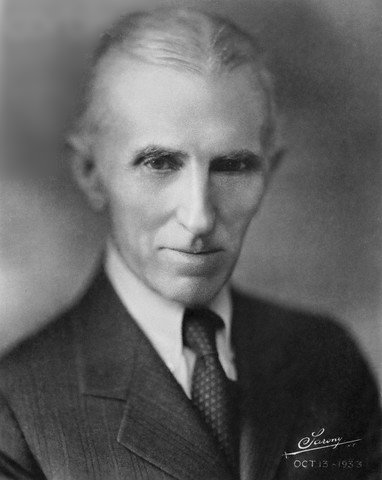

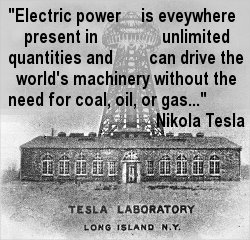
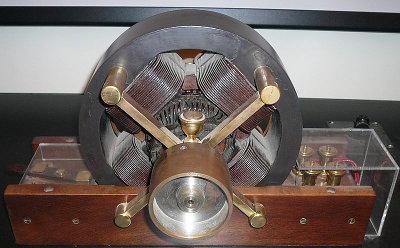
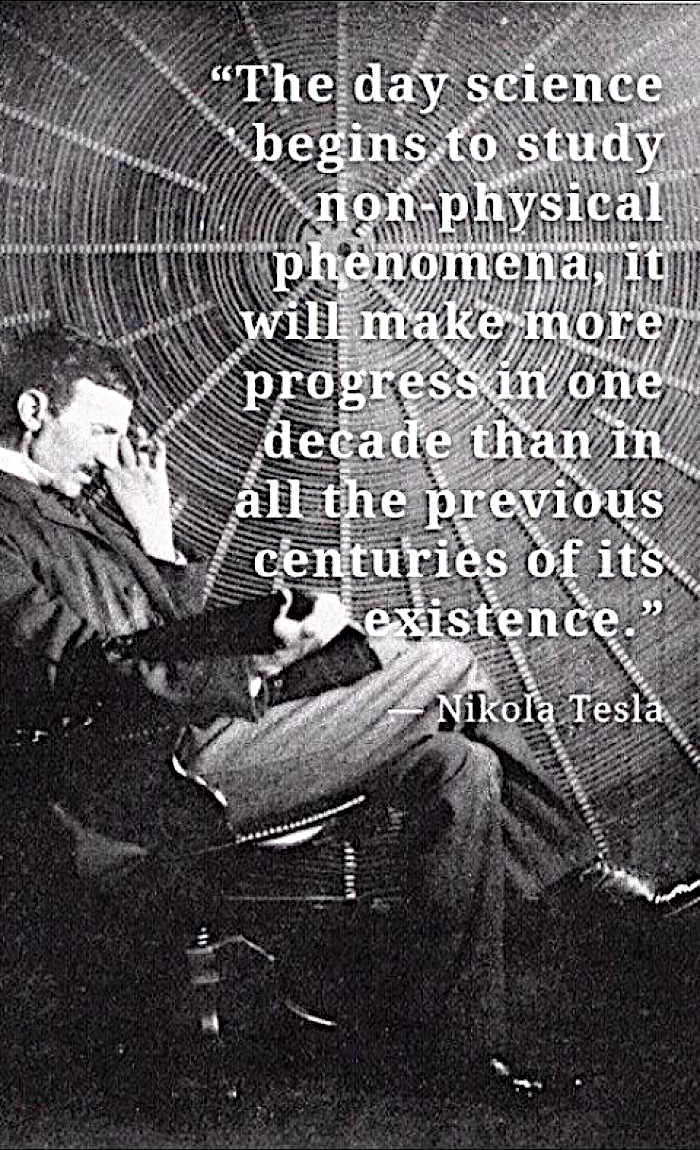
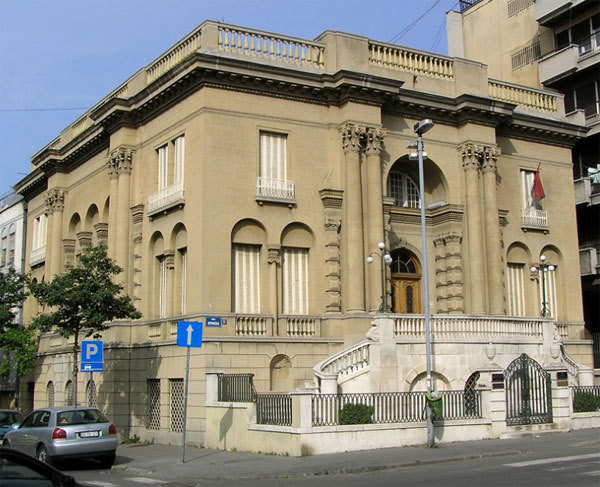
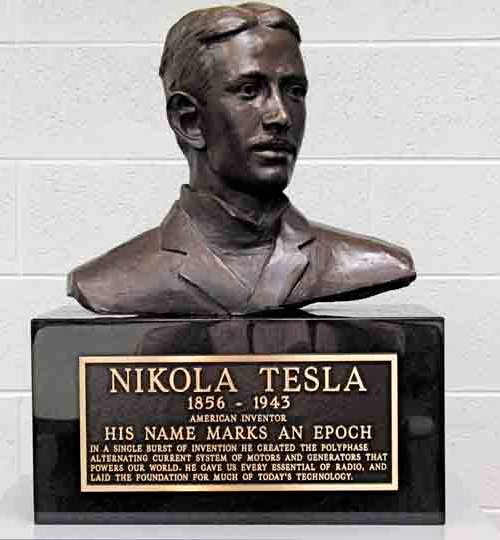
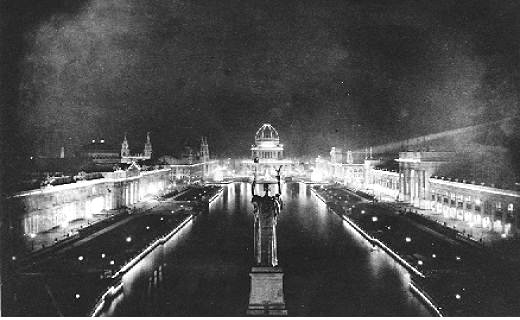
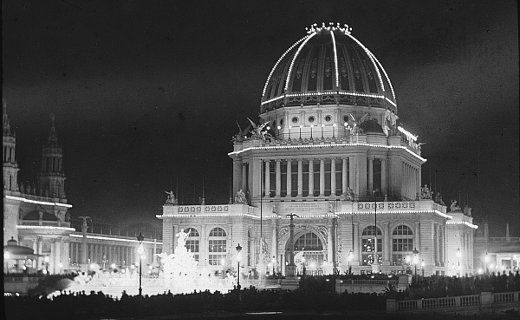
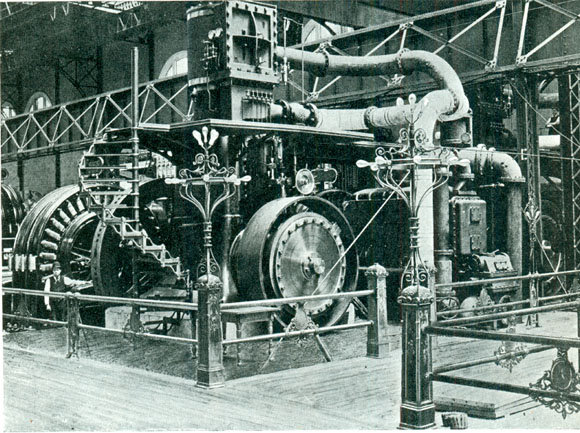
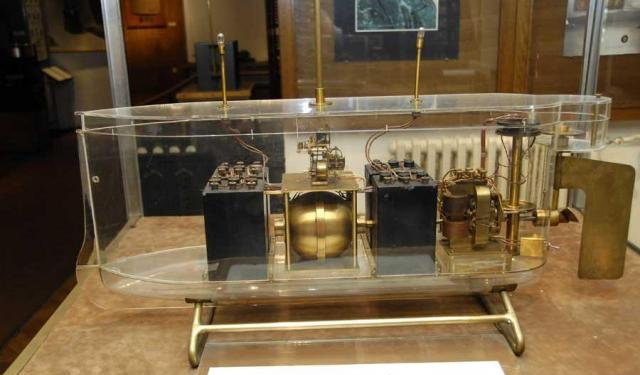
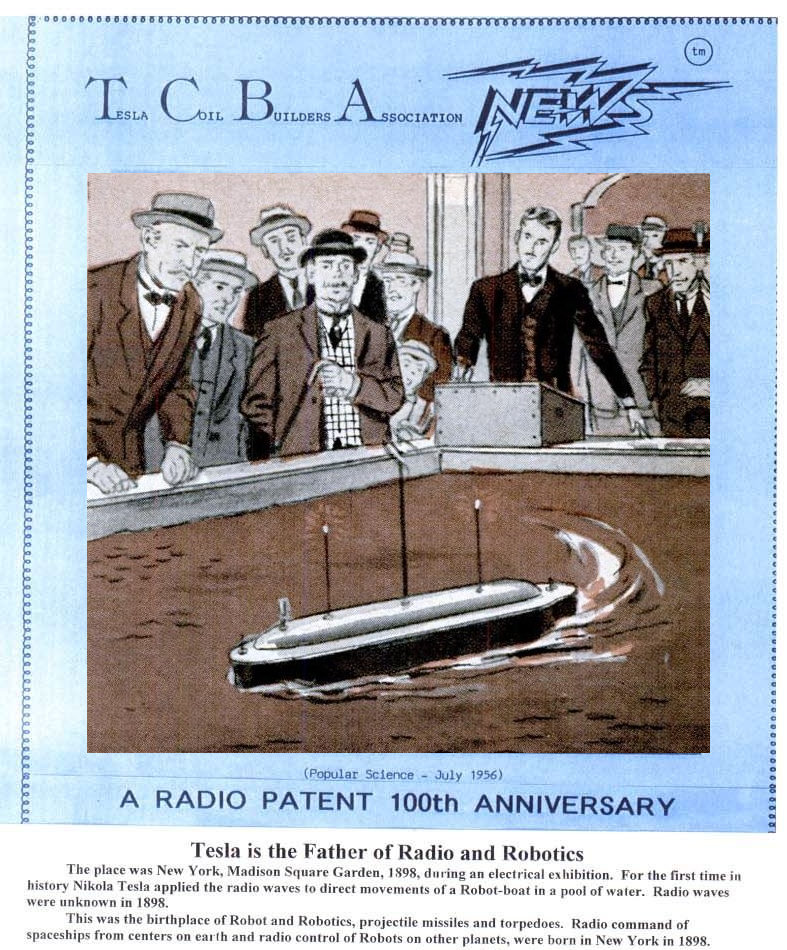
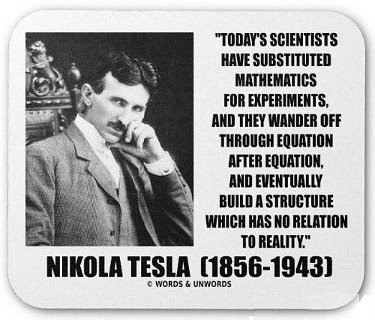 In England, a young Italian experimenter named Marconi was hard at work trying to build a device for wireless telegraphy. His device had only a two-circuit system, which some said could not transmit “across a pond.” Later, in 1901, Marconi set up long-distance demonstrations, using a Tesla oscillator, Tesla coil, to transmit the signals across the English Channel.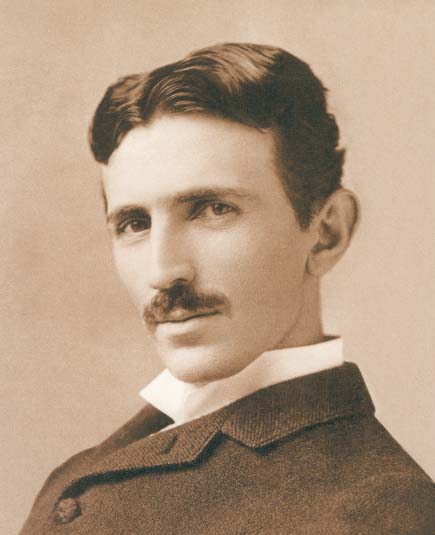
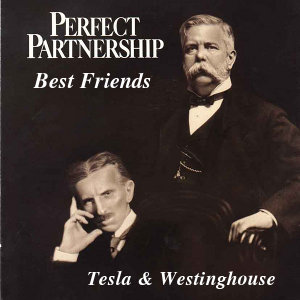

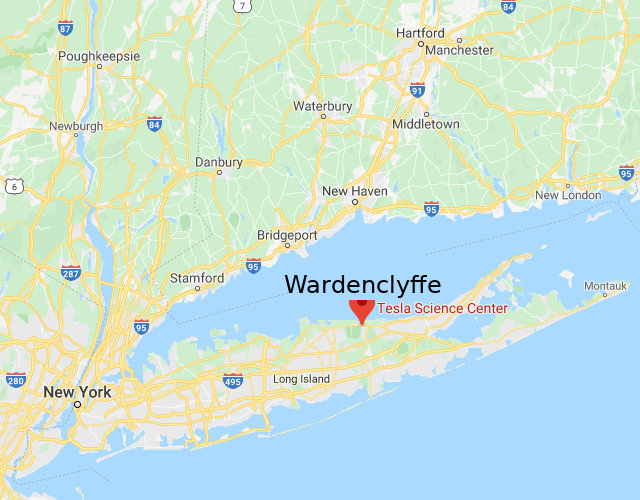
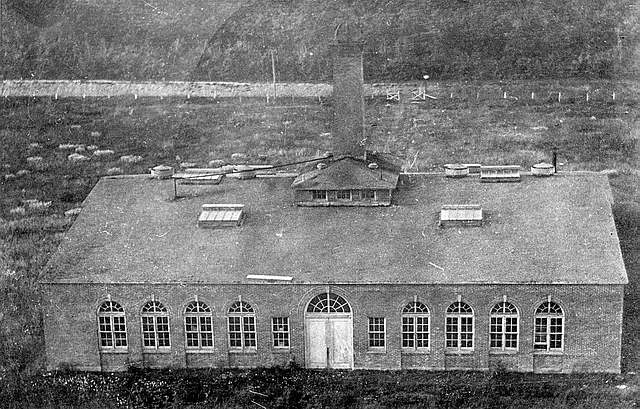
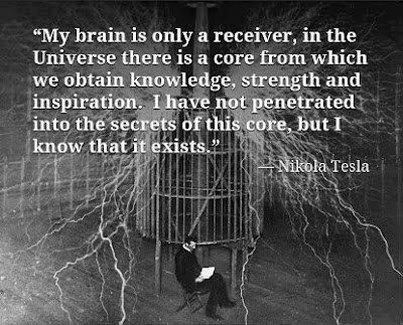
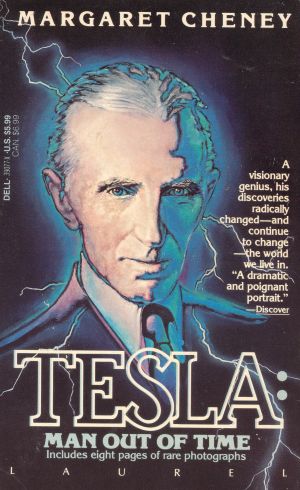
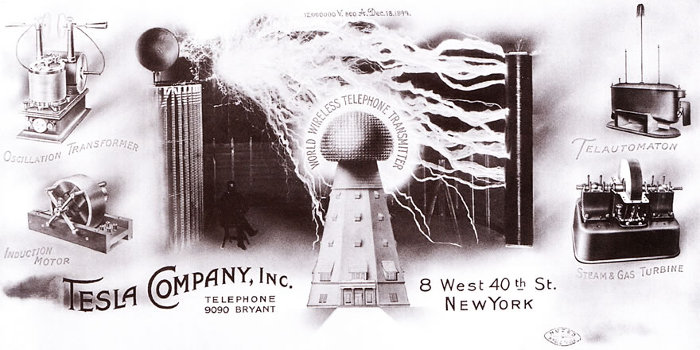
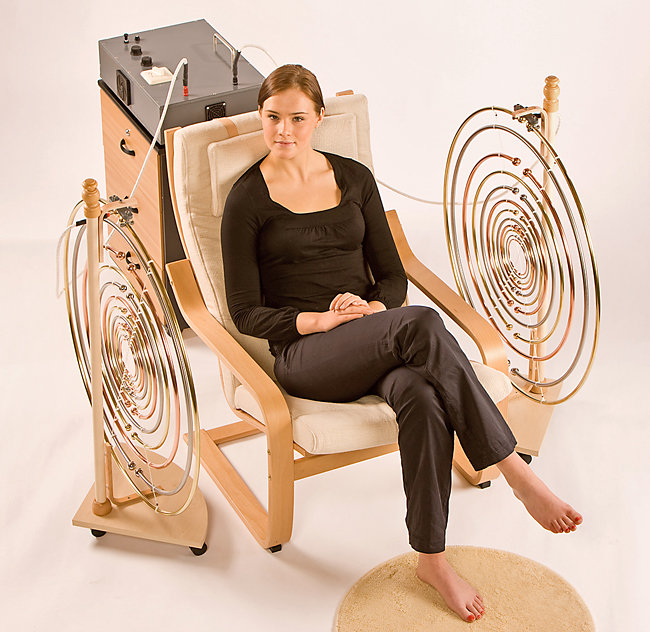
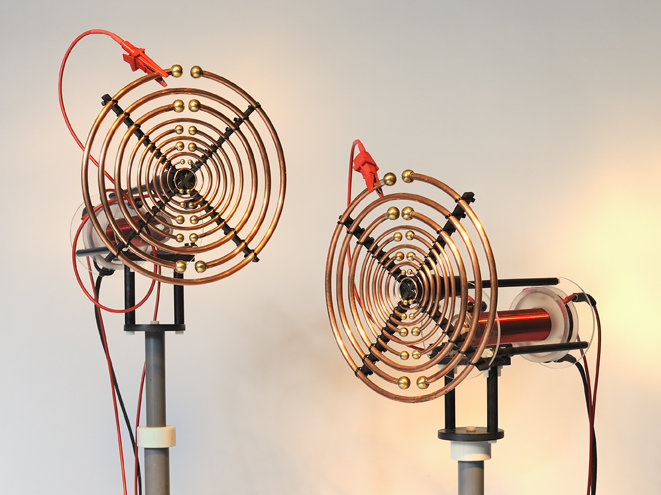
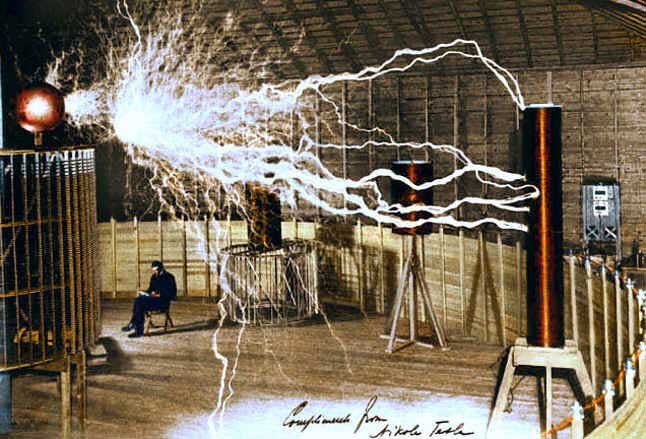
I dedicate our technology to Engr. Rudolf Diesel and the super genius Nicola Tesla. I hope that it will prevent the demise of the diesel engine.